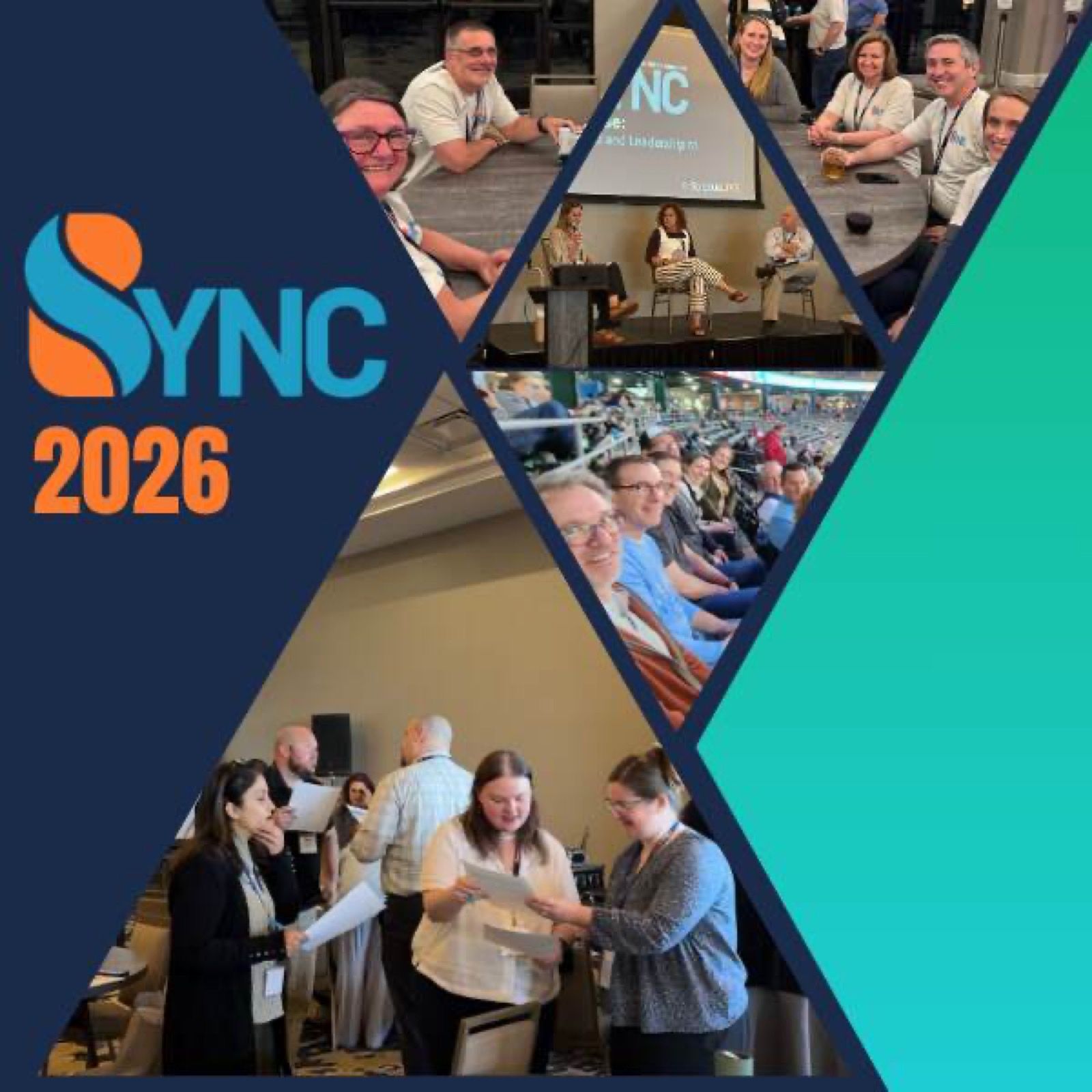
Three days. 25 sessions. The spirit and heart of the nonprofit world joined in one room.
SYNC 2026 just wrapped in Virginia Beach, and the energy this community brought to the conversation exceeded every expectation.
This year’s theme was Beyond Data: AI for Human Connection. Every session, every keynote, every peer roundtable came back to the same question: how do we build technology that makes the human side of this work stronger?
Here is what happened at SYNC 2026, session by session, and why it matters for every nonprofit thinking about what comes next.
Opening Keynote: Innovating Toward the Future
Speaker: Jim Funari, CEO and Co-Founder
Jim opened the conference by doing something rare for a tech CEO: he started with accountability. At SYNC 2025, StratusLIVE made four specific product commitments. Jim walked the room through each one and confirmed that all four shipped.
Agentic AI that acts on behalf of fundraisers is live as Ignite Intelligence. A native constituent layer with AI action plans is now Ignite CRM. Financial processing built natively in Ignite is Ignite Finance, complete with full subledger, batch control, and GL integration. And a lighter, Ignite-native workplace giving solution is available now as Ignite Give at Work.
Jim then shared that the team used AI to synthesize two years of NPS verbatims, Client Success conversations, and enhancement requests. Five themes emerged with striking consistency: fundraisers want simpler, more intuitive experiences. They want AI embedded in workflows, not sitting on the side. Digital engagement data needs to live where relationship decisions happen. Delivery speed matters. And organizations want to grow capability without growing complexity.
That set the tone for the entire week.
Connected Intelligence: The Future of Fundraising is Integrated
Speaker: Jim Funari, CEO and Co-Founder
Jim’s second keynote unpacked the idea of connected intelligence: AI that works across a fully integrated platform to know a donor completely, reason about them continuously, and engage them coherently across every channel. The argument is that AI is only as useful as the data it can access and the systems it can reach. Isolated tools produce isolated insights. Integrated platforms produce intelligence that spans the full donor lifecycle.
For any nonprofit still running fragmented systems where the CRM, the online giving platform, the marketing engine, and the finance tools operate independently, this session made the strategic case for consolidation.
The Modern Fundraising Ops Team: Roles, Skills, and AI Readiness
Speaker: Katie Rudnicki, Product Manager, Nonprofit CRM
This was one of the most forward-looking sessions at the conference. Katie presented a four-layer model for the modern ops team: Data and Governance, Systems and Integration, Analytics and Insights, and Donor Experience.
The traditional view of fundraising ops (CRM administration, gift processing, reporting) is giving way to a strategic function that includes data strategy, donor journey design, and AI governance. The session challenged a common assumption: that AI readiness is primarily a technology problem. In practice, the organizations getting the most from AI are the ones that have restructured their teams around the capabilities. Training, role clarity, and a willingness to rethink workflows come first.
If your operations team still looks the way it did five years ago, this session was a call to action.
Human-Centered Data Entry
Speakers: Lori Combs, Director of Solution Engineering; Nick Mills, Business Analyst
This session made the case that data quality is fundamentally a human experience problem. Lori and Nick identified four patterns that undermine data quality: friction, inconsistency, no feedback loop, and workarounds (shadow spreadsheets, memo fields used as catch-alls, required fields filled with “N/A”).
The path to better data runs through making the experience of entering data better for the humans doing it. The session also previewed a prototype gift entry experience in development that applies these principles directly. For anyone who has ever wondered why their CRM data is messy, this session provided a clear framework for fixing it at the source.
You Spoke, We Listened
Speakers: Rob Monti, Katie Rudnicki, Alicia Stevens
A candid look at how client feedback is shaping the product roadmap. The session covered the Ignite Engagement roadmap for 2026 and beyond, with three overarching goals: refocus on core modules, introduce AI-assisted and agentic workflows for opportunity creation and supporter interactions, and use AI to better leverage the data organizations already have in Ignite. The team walked through what is shipping now (new agency workspace, fundraising widgets, revamped donation page configuration), what is coming near-term (enhanced P2P, milestone badges, geo-fenced event check-in), and what is on the longer horizon.
Workplace Giving, Reimagined: A Strategic Framework for Growth
Speakers: Gary Carr, CFO; Jennifer Mitchell, Project Manager; Laura Prengaman, CSR Sr. Program Specialist
Workplace giving got its own dedicated session, and for good reason. The session traced the evolution from the first scalable online pledge system in 2000 through today’s landscape of 100+ online giving solutions, CSR platforms, and shifting participation demographics.
The core argument: workplace giving has been treated as an annual campaign when it should function as a year-round engagement channel. The session introduced StratusLIVE’s response through two product paths, including the first-ever business prospecting solution built specifically for workplace giving. For United Ways and other organizations where workplace giving represents a meaningful revenue channel, this session provided the strategic framework to grow it.
The Right Donor, Right Now: Rethinking Prospecting Strategy
Speakers: John Funari, CTO and Co-Founder; Lori Combs, Director of Solution Engineering
John and Lori walked through how organizations can use constituent data already in StratusLIVE to surface high-potential prospects: engagement data, participation records, donor history, and prospect research data including wealth screening integrations with WealthEngine and iWave.
The highlight was a preview of AI agent prototypes that can automate parts of the prospecting workflow, including data synthesis, prospect scoring, and recommended next actions. This is where the connected intelligence vision becomes tangible. When AI operates across a fully integrated data set, it can surface opportunities that no human analyst would find by looking at a single data source.
Making Reports Useful Again: Dashboards Designed for Decisions
Speaker: Paula Elrod, Project Manager
Paula opened with a truth that resonated across the room: most reports get opened once and forgotten. The problem is that organizations design dashboards for data when they should be designing for decisions. Reports answer “what happened.” Leaders need “what should I do?”
The session covered principles for dashboard adoption, common mistakes, and practical guidance for building dashboards in StratusLIVE that people actually use. If your leadership team is not looking at the dashboards your team built, this session explained why and how to fix it.
Tailoring Your CRM User Experience for Greater Productivity
Speaker: Joel Parker, Project Manager
Joel made the case that CRM should work the way your team works, and presented a four-step blueprint for getting there: Listen (stakeholder interviews and workflow observation), Design, Build, and Iterate. The session covered how to identify user groups and business units, prioritize by impact, and plan for regular feedback loops as teams grow and processes change.
The practical takeaway: start with the largest or most CRM-dependent teams to prove value fast and build organizational momentum.
Peer Roundtables
The peer roundtables were one of the most talked-about parts of the conference. Attendees chose from topics including AI adoption in practice, data quality ownership, technology adoption, donor stewardship, personalization and privacy, and what it means to be an AI-ready organization.
The conversations were candid, unscripted, and driven entirely by the people in the room. This is the part of SYNC that you cannot get from a webinar or a product update email. Year after year, attendees tell us these conversations are among the most important parts of the week.
Keynote: Innovation in Action: Real Solutions from the Field
Moderator: Alicia Stevens, Director of Client Success
Wednesday’s client keynote featured two organizations with two very different challenges and two very real results.
United Way for Southeastern Michigan replaced fragmented systems (referrals tracked in spreadsheets, no single view of services, inconsistent reporting) with a StratusLIVE CRM-based Client and Case Management solution that now processes thousands of referrals and supports over 10,000 clients annually. They also shared how they reimagined onboarding and training to keep pace with evolving needs against a backdrop of funding constraints and workforce attrition.
ArtsWave in Greater Cincinnati responded to a declining donor base by launching a native mobile app that has attracted 20,000 downloads and 6,000 paid members. Their approach demonstrated what becomes possible when an organization uses technology to meet constituents where they are.
These were not theoretical case studies. These were practitioners sharing what they built, what they learned, and what they would do differently.
More Mission and Less Mess: A Fireside Chat with Dotdigital
Speakers: Melissa Sturtzel, Dotdigital; Bob Williamson, United Way of Central and Northeastern Connecticut
Dotdigital and UWCNEC sat down for a fireside chat on transforming marketing strategy from reactive to proactive and automated. The session introduced a “Crawl, Walk, Run” model for building efficient, scalable engagement engines that connect CRM data to fundraising goals. Dotdigital also showcased their AI-powered marketing tools, including AI brand voice for authentic content creation, predictive analytics with CLV and churn models, and a two-way data integration with StratusLIVE that puts marketing automation directly inside the CRM workflow.
A special thank you to Dotdigital for their sponsorship of SYNC 2026 and for bringing real practitioner stories to the stage.
Benchmark Yourself: Insights from Across the StratusLIVE Community
Speakers: Gary Carr, CFO; Danielle Reilly, Sr. Business Intelligence Analyst
This session put real numbers behind the retention conversation. An analysis of 11 million constituent records across 30 CRM clients revealed that 87% of all records had no gift in 36 or more months. The annual revenue lost to donor churn across the StratusLIVE community totaled $13.7 million, and the estimated cost to acquire replacement donors was $21.4 million.
At the national level, U.S. charitable giving reached $592.5 billion in 2024. That represents 3.3% real growth after inflation. But approximately 80% of first-time donors never give a second gift, and the sector-wide donor retention rate sits at roughly 32%.
Gary challenged the room: the real question is not whether the sector is growing. It is whether your organization is keeping the donors it already has.
The Stewardship Gap: Turning Acknowledgment Into Relationship
Speakers: Debbie Snyder, CRO; Brendan Murphy, Director of Enterprise Client Accounts
This session connected directly to the benchmark data. According to the Fundraising Effectiveness Project, 57% of first-time donors never make a second gift. It costs three times more to acquire a new donor than to retain one. And 80% of lapsed donors say no one made them feel their gift mattered. The response window before a new donor loses connection is less than 48 hours.
Debbie and Brendan introduced a four-pillar stewardship framework: Milestones, Impact, Recognition, and Engagement. The session included a 30-day quick start plan and a five-step build process that any organization can begin implementing immediately using data already in their CRM.
If SYNC 2026 had a single “go do this tomorrow” session, this was it.
Keynote: Platform Future and Roadmap
Speakers: Jim Funari, CEO; John Funari, CTO; Brett Meyer, VP Professional Services
The roadmap keynote was structured around “Both Paths Forward”: the Tailored Experience (StratusLIVE 365 on Microsoft Dynamics) and the Guided Experience (StratusLIVE Ignite).
The Tailored Experience path covers customization through model-driven apps, UI and form improvements, the agency portal migration, and Ignite Finance for 365 CRM. The platform manages over 20 million records with SOC 2 Type II compliance and 99.9% uptime.
The Guided Experience path covers Ignite CRM, Fundraising, and Marketing modules, agent capabilities and playbooks, new agents built from client feedback, and expanded engagement methods.
A shared ecosystem sits underneath both paths: Ignite Intelligence, Digital Fundraising, Self-Service, Give at Work, and Partnerships. The message was clear: regardless of which path an organization is on, the investment is equal and the ecosystem is shared.
Top 10 Trends in Nonprofit Development and Fundraising
Speakers: Kelly Perry, Senior Digital Marketing Manager; Debbie Snyder, CRO
Kelly and Debbie synthesized data from Giving USA, the Fundraising Effectiveness Project, M+R Benchmarks, and the Peer-to-Peer Professional Forum into ten trends with strategic implications and calls to action. The session opened with live audience polling through Mentimeter and grounded every trend in real data.
The headline: philanthropy is still growing, but not evenly. Major gifts and high-capacity donors are driving gains. DAF and corporate channels are expanding fast. But active donor counts are declining sector-wide, smaller donors are disappearing from files, and acquisition costs keep rising. Base donor erosion is a strategic risk, not a campaign risk.
AI 101: Prompt Engineering, Use Cases & Data Safety
Speaker: Brett Meyer, VP of Professional Services
Brett led a practitioner’s guide to working with AI, opening with a framing that set the tone: think of AI like a very well-read intern. It has read millions of documents, spots patterns fast, needs clear instructions, and can be confidently wrong.
The session introduced the CRAFT framework for prompt engineering and walked through real-world nonprofit use cases. The data safety portion made the case that data hygiene is a prerequisite for effective AI adoption. Organizations with clean, well-structured data will get dramatically more value from AI tools.
Making the Case: Getting Leadership to Embrace Tech
Speakers: Gary Carr, CFO; Kelly Perry, Senior Digital Marketing Manager; Debbie Snyder, CRO
This panel tackled one of the most common barriers to technology adoption: getting leadership buy-in. The session reframed the typical ROI conversation. Instead of starting with return on investment, start with the gaps. The panel introduced three buckets that every technology conversation falls into: procurement and contract timing, expense and cost management, and growth opportunity.
A data point that resonated across the room: most organizations are actively using only 40 to 60 percent of their platform capabilities. The utilization gap is almost universal. The session gave attendees specific language, frameworks, and real-world examples to bring back to their own leadership teams.
Ignite Engagement: What’s New and What’s Next
Speakers: Jennifer Mitchell, Project Manager; Rob Monti, UI Lead Designer
Rob and Jennifer traced the history of Ignite from its origins during the COVID-era digital scramble through the AI inflection point that is shaping its future. The session covered features that have shipped, what is on the near-term roadmap, and how to take full advantage of the platform’s digital fundraising capabilities. Attendees got a first look at what is coming to Ignite Engagement and had direct input on priorities.
Agency Portal to Partnerships
Speakers: Jim Funari, CEO; Rob Monti, UI Lead Designer; Kelly Perry, Senior Digital Marketing Manager
For United Way organizations, this was a significant session. The team walked through the transition from the legacy agency portal (standalone system, separate SQL database per org, limited reporting, dated interface) to Partnerships in Ignite (native experience, centralized Snowflake data warehouse, real-time reporting, modern responsive UI, streamlined onboarding).
V1 includes self-service agency onboarding, bulk invite capabilities, designation matching to IRS master records, and simplified user management. The session covered what changes, what stays, and what gets dramatically better.
More Than Software: Services to Help You Succeed
Speaker: Brett Meyer, VP of Professional Services
Brett introduced an expanded services portfolio designed to close the gap between what the platform can do and what organizations actually use. The session identified four challenges that drive this gap: configuration drift as staff turns over and processes evolve, data that accumulates without becoming actionable, AI uncertainty without a privacy framework, and tribal knowledge that lives with one or two people and leaves with them.
The new services portfolio covers Platform Optimization, Business Process Optimization, AI Adoption, CSR Shared Services, Analytics, Digital Fundraising, and CRM Training and Education.
Donor Dollars Matter, but Relationships Sustain
Speakers: Lori Combs, Director of Solution Engineering; Jennifer Mitchell, Project Manager
Lori and Jennifer demonstrated how StratusLIVE’s Ignite Volunteer, Events, and Community Groups modules create a 360-degree view of every constituent. The session addressed a reality that many organizations are still managing: constituent data scattered across Excel sheets, separate systems, and Access databases. When you understand the whole journey (not just the financial transaction), you build stronger, more enduring relationships.
Closing Keynote: Six Themes Shaping the Next 1 to 3 Years
Speaker: Jim Funari, CEO and Co-Founder
Jim closed the conference with a forward-looking keynote on nonprofit technology, architecture, and AI enablement. Six themes:
1. User experience will become simpler, more diverse, and more tailored. Rigid, form-heavy systems are giving way to guided, conversational, role-based workflows. Each role needs its own experience.
2. Integrated platforms will outperform best-of-breed stacks. Personalization requires shared data, shared workflows, and a shared intelligence layer. AI works best when it sits on top of a trusted data backbone.
3. Horizontal CRM vendors remain strong, but vertical pressure is growing. Large organizations with deep IT teams get real value from horizontal platforms. Mid-market nonprofits win with purpose-built vertical platforms that deliver faster time to value and clearer economics.
4. AI will move from assistance to action. The ask is for AI that participates in workflows, not a feature that waits to be consulted.
5. Data unification will determine the quality of personalization. Fragmented data produces fragmented experiences.
6. The promise: simplicity, trust, and measurable impact. That is where this industry is headed, and that is what StratusLIVE is building toward.
A New Brand for a New Era
SYNC 2026 also marked the public debut of StratusLIVE’s refreshed brand identity. The updated visual system reflects where the company is headed: a modern, AI-forward nonprofit technology platform built for organizations that need integrated tools across fundraising, CRM, finance, marketing, engagement, and workplace giving. The SYNC conference was the first place clients experienced the new brand in person, and the energy in the room confirmed what the team had been building toward.
Thank You
To every client, partner, and team member who joined us in Virginia Beach: thank you. SYNC exists because of the community that shows up, shares openly, and pushes us to build a better platform. The conversations from this week is already shaping what comes next.
We’ve returned to the office energized. We hope you are too!