Key takeaways
- Predictive scoring turns backward-looking reports into probabilities: who is likely to upgrade, lapse, convert to recurring, or respond to a larger ask.
- Models are only as good as the record. Gift frequency, recency, lifetime total, event attendance, email engagement, and volunteer hours predict best. Deduplicate first.
- Treat propensity scores as decision support. A high score opens a conversation, and the gift officer still builds the relationship.
- Behavioral signals matter as much as gift data. Three visits to the planned-giving page or a skipped annual gala say something a gift ledger cannot.
- Churn models flag declining engagement before the lapse, and ask-amount and cadence models tune how much to ask and when.
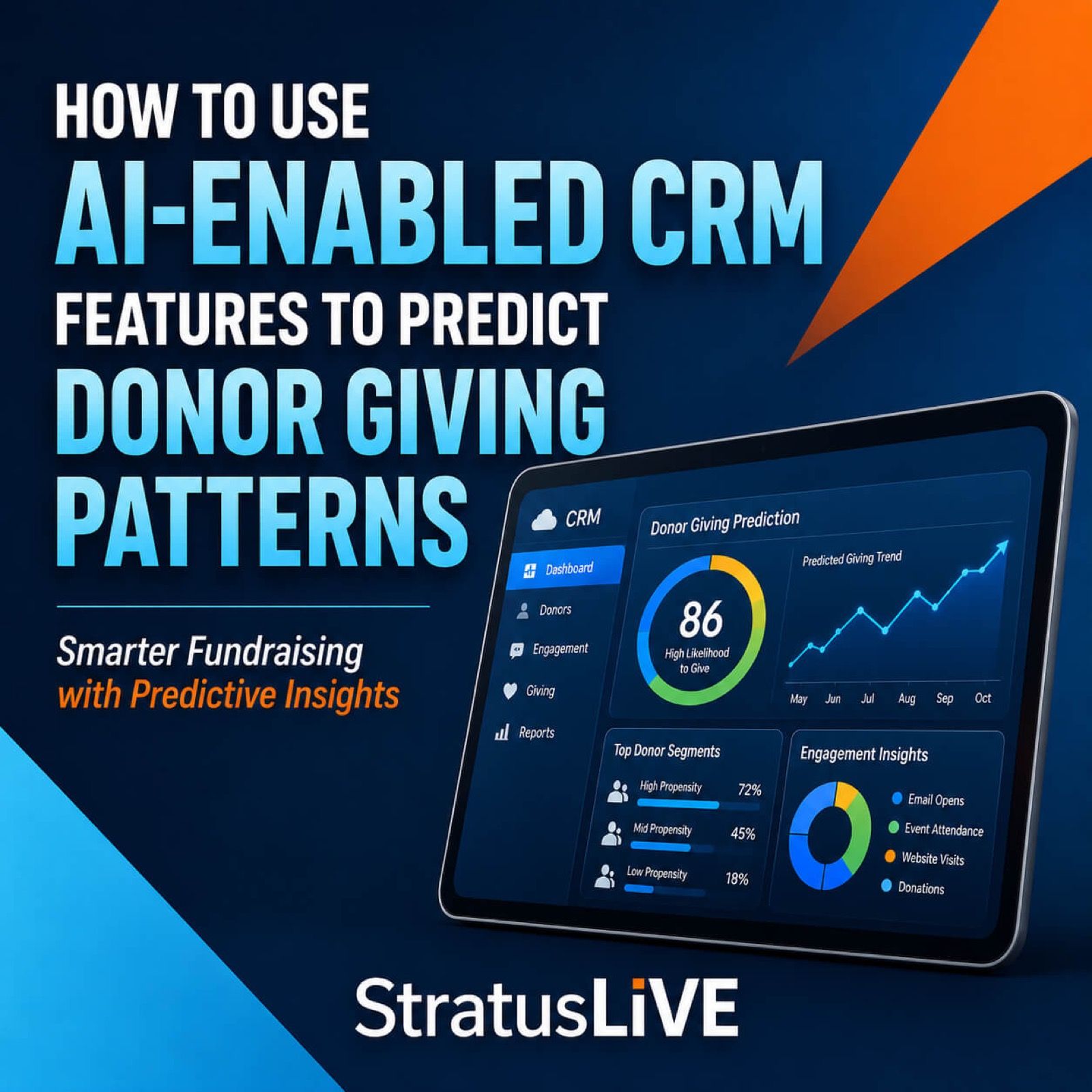
Nonprofit organizations sit on a wealth of constituent data, yet most struggle to translate historical gift records and engagement metrics into forward-looking strategy. The ability to predict donor giving patterns using AI-enabled CRM features has moved from a theoretical advantage to a practical necessity, as fundraising teams face growing pressure to raise more while spending less on outreach. Modern CRM platforms built for mission-driven organizations now embed machine learning, natural language processing, and predictive scoring directly into the tools development officers use every day. These capabilities allow fundraisers to anticipate behavior rather than simply react to it, shifting the entire approach to donor stewardship. What follows is a structured guide to putting these features to work, covering everything from data preparation and propensity scoring to churn prevention and data integrity.
The Evolution of Donor Data in AI-Enabled CRMs
For decades, nonprofit CRMs served primarily as digital filing cabinets, storing gift histories, contact details, and event attendance records. The shift toward AI-enabled platforms has transformed these repositories into prediction engines that surface patterns no human analyst could detect at scale. Platforms like Salesforce Nonprofit Cloud, Bloomerang, and Microsoft Dynamics 365 for Nonprofits now offer built-in intelligence layers that process millions of data points and return constituent-level forecasts.
Transitioning from Reactive to Predictive Analytics
Traditional fundraising analytics focused on backward-looking reports: total dollars raised last quarter, average gift size by campaign, and year-over-year retention rates. These reports are valuable, but they describe what already happened rather than what is likely to happen next. Predictive analytics flips this model by applying statistical algorithms to historical data, generating probability scores for future actions such as a constituent upgrading their annual gift or lapsing entirely. The practical difference is significant: a reactive team sends the same appeal to every donor on a list, while a predictive team tailors the ask amount, channel, and timing to each individual based on modeled behavior.
Key Data Points for Training AI Models
AI models are only as reliable as the data fed into them. The most predictive fields for donor behavior include gift frequency, recency of last gift, lifetime giving total, average gift amount, event attendance history, email open and click rates, volunteer hours, and wealth screening indicators. Demographic data such as age, geography, and household composition can add context, though organizations must handle these fields carefully to comply with GDPR and other privacy regulations. Clean, deduplicated records are essential: merging duplicate constituent profiles and standardizing address formats should precede any model training. Many CRM platforms offer built-in data health dashboards that flag incomplete records or potential duplicates before the AI layer ingests them.
Leveraging Machine Learning for Propensity Scoring
Propensity scoring assigns a numerical likelihood to a specific donor action, such as making a major gift, becoming a recurring donor, or attending a gala. Machine learning models generate these scores by identifying correlations across thousands of constituent records and weighting each factor by its predictive power. The result is a ranked list that helps development officers focus their time and energy on the constituents most likely to respond.
Identifying Likely Major Donors
Major gift officers often manage portfolios of 100 to 150 prospects, so accurate prioritization directly affects revenue. AI-enabled CRMs can flag constituents whose giving trajectory, wealth indicators, and engagement frequency suggest readiness for a larger ask. Salesforce Einstein, for example, can score prospects on a 0-to-100 scale and surface the top candidates in a dashboard view. Organizations that have adopted propensity scoring for major gift identification report portfolio conversion improvements between 15 and 30 percent, according to 2025 benchmarking data from the Association of Fundraising Professionals. The key is to treat these scores as decision support rather than decision replacement: a high score opens a conversation, but the gift officer still needs to build the relationship.
Predicting Recurring Gift Potential
Recurring donors provide predictable revenue and tend to have higher lifetime value than one-time givers. AI models can identify single-gift donors who exhibit behavioral signals associated with future recurring commitments, such as making gifts at regular intervals, engaging with monthly impact reports, or responding to sustainer-focused email campaigns. Once the CRM flags these constituents, automated workflows can trigger a personalized ask to convert them into monthly or quarterly givers. Bloomerang and Virtuous both offer native recurring gift propensity features that track conversion likelihood over rolling 90-day windows.
Analyzing Behavioral Triggers and Engagement Signals
Raw gift data tells only part of the story. Behavioral signals captured across email, social media, website visits, and in-person events reveal intent and sentiment that numeric records alone cannot convey. AI-enabled CRMs aggregate these signals into unified constituent profiles, creating a richer picture of each donor’s relationship with the organization.
Sentiment Analysis of Donor Communication
Natural language processing tools embedded in CRMs can analyze the tone and content of donor emails, survey responses, and even handwritten notes that have been digitized. A constituent who uses enthusiastic language about a recent program outcome may be primed for a stewardship touch or an upgraded ask. Conversely, a donor whose correspondence reflects frustration or disengagement may need immediate attention from a relationship manager. Salesforce Einstein Sentiment and Microsoft Azure AI Language both offer sentiment classification that can be integrated into nonprofit CRM workflows. These tools categorize communications as positive, negative, or neutral and assign confidence scores, giving frontline staff a quick read on constituent mood before picking up the phone.
Tracking Digital Footprints and Event Participation
Website behavior and event attendance patterns offer strong predictive signals. A constituent who visits the planned giving page three times in a month is signaling interest in legacy gifts, even if they have not explicitly said so. Similarly, a donor who attends every annual gala but skips the most recent one may be showing early signs of disengagement. AI models can weight these digital and in-person interactions alongside gift data to produce more accurate forecasts. CRMs that integrate with marketing automation platforms like HubSpot for Nonprofits or Pardot can pull these behavioral data points directly into the constituent record without manual entry.
Optimizing Ask Amounts and Outreach Timing
Knowing who to ask is only half the equation. Knowing how much to ask for and when to make the request can mean the difference between a gift and a missed opportunity. AI features within modern CRMs address both variables with data-driven precision.
Dynamic Suggested Giving Tiers
Static gift arrays on donation forms often leave money on the table. AI-enabled CRMs can generate personalized suggested amounts based on a constituent’s giving history, capacity indicators, and peer group behavior. If a donor’s last three gifts averaged $250 and their wealth-screening data suggest higher capacity, the CRM might recommend presenting tiers of $300, $500, and $1,000 on their next solicitation. Platforms such as DonorPerfect and Neon CRM have introduced dynamic ask amount features that adjust in real time based on the donor profile being served. This approach respects the donor’s history while gently encouraging growth, and it removes the guesswork that often leads to under-asking.
Automating the Ideal Communication Cadence
Sending too many appeals risks donor fatigue, while too few touches can lead to disengagement. Machine learning models can analyze response patterns across the constituent base to determine the ideal frequency, channel, and day of week for outreach. Some donors respond best to a Tuesday morning email, while others are more likely to give after receiving a direct mail piece on a Friday. CRM workflow automation tools, such as Salesforce Flow or Microsoft Power Automate, can execute these personalized cadences at scale once the AI model identifies the optimal schedule for each segment. The result is a communication plan that feels personal even when it runs automatically.
Mitigating Donor Churn with Early Warning Systems
Donor attrition remains one of the most expensive problems in the nonprofit sector, with the average first-year donor retention rate hovering around 20 percent according to the Fundraising Effectiveness Project. AI-enabled CRMs can identify at-risk constituents before they lapse, giving development teams a window to intervene.
Detecting Lapsing Patterns Before They Happen
Early warning models track a combination of declining engagement metrics: fewer email opens, reduced event attendance, longer intervals between gifts, and smaller gift amounts. When a constituent’s behavior crosses a threshold that the model associates with lapsing, the CRM generates an alert or automatically enrolls the donor in a re-engagement workflow. These workflows might include a personal thank-you call, an impact report highlighting how their past gifts made a difference, or a survey asking for feedback. Organizations using churn prediction models have reported retention improvements of 10 to 18 percent within the first year of implementation, a meaningful gain given the cost of acquiring new donors.
Best Practices for Maintaining AI Data Integrity
The predictive power of any AI feature depends entirely on the quality and completeness of the underlying data. Nonprofit teams should establish clear data governance policies that define who can create, edit, and merge constituent records. Regular audits, ideally quarterly, should check for duplicate profiles, outdated contact information, and inconsistent field usage. Staff training is equally important: gift processors, event coordinators, and volunteer managers all contribute data that feeds AI models, so everyone must understand the standards. Organizations subject to GDPR, HIPAA, or SOC 2 compliance should also ensure that their CRM vendor meets these requirements, particularly when AI features process sensitive donor or beneficiary information. Finally, treat AI outputs as living tools: review model accuracy every six months, retrain models as giving patterns shift, and solicit feedback from frontline fundraisers about whether the scores and recommendations align with their on-the-ground experience.
Turning Predictions into Fundraising Strategy
AI-enabled CRM features offer nonprofit organizations a genuine path from data collection to data-driven decision making. The ability to predict donor giving patterns, identify churn risks, and personalize outreach timing transforms fundraising from a volume game into a precision discipline. Success, however, depends on clean data, trained staff, and a willingness to act on what the models reveal. Organizations considering this shift should start with a single use case, such as major gift propensity scoring, prove its value with measurable results, and expand from there. Request scenario-based demonstrations from CRM vendors, consult peer organizations of similar size, and budget for the total cost of ownership, including implementation, training, and ongoing administration. The nonprofits that treat AI as a practical tool rather than a buzzword will be the ones that build stronger, more sustainable donor relationships in the years ahead.