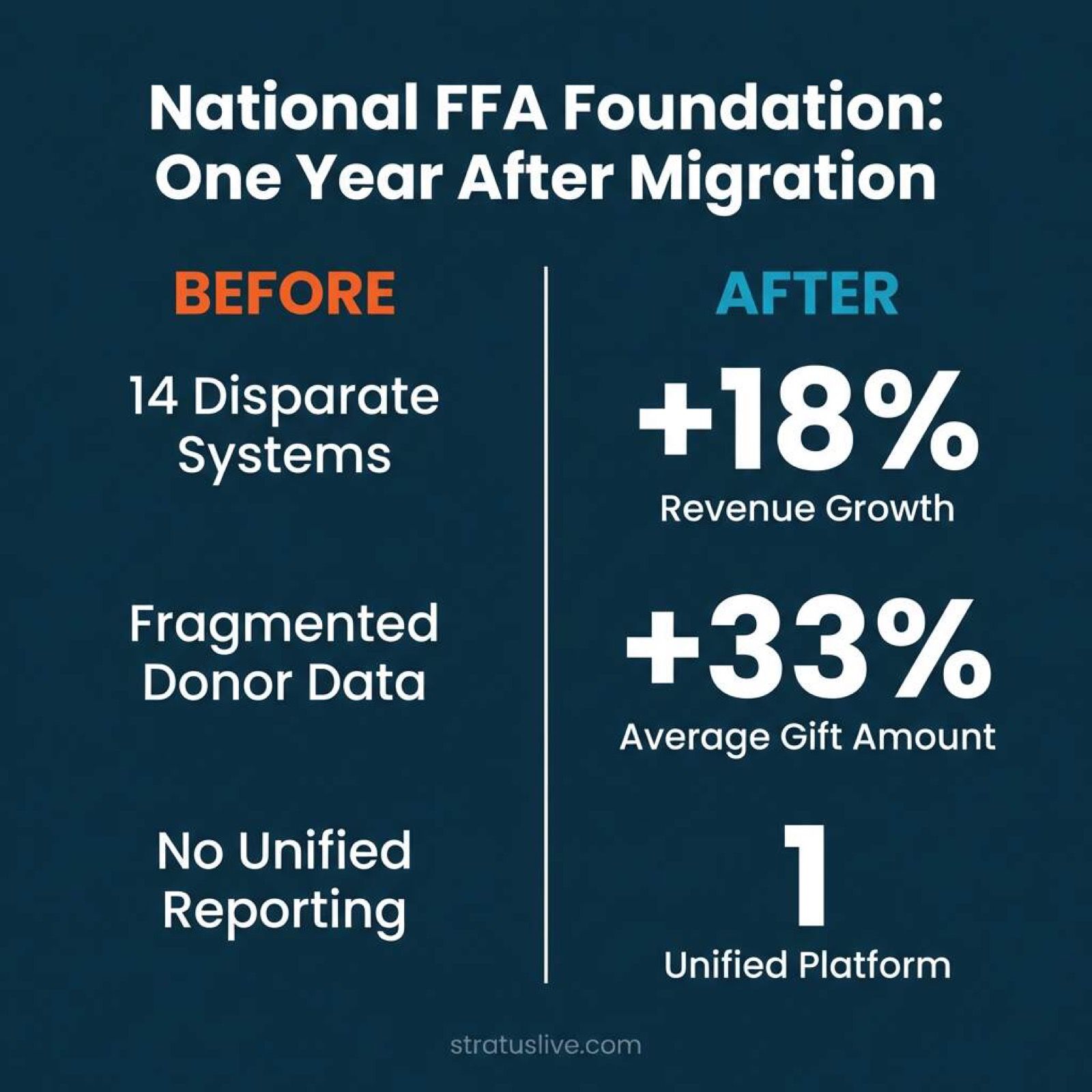
When a nonprofit is managing donor data, campaign activity, marketing solicitations, and membership records across 14 separate technology platforms, something always falls through the cracks. Reporting takes longer than it should. Donor communications rely on incomplete data. Staff spend their time reconciling systems instead of building relationships.
That was the reality National FFA Foundation faced before partnering with StratusLIVE. Within one year of migrating to a single, unified platform, the Foundation reported a record-setting fundraising year: an 18% increase in total payment revenue and a 33% increase in average gift amount.
Here is what drove that transformation, and what it means for nonprofits navigating similar challenges today.
The Problem: 14 Platforms, Zero Integration
National FFA Foundation supports one of the largest youth agricultural organizations in the country, serving 500,000 student members and hundreds of thousands of alumni and donors. Managing that volume of relationships requires technology that can keep pace.
Before the migration, the Foundation relied on 14 disparate technology platforms to handle donation processing and tracking, marketing solicitations, and membership management. None of these platforms communicated with each other. Each system held a piece of the picture, but no single source of truth existed. Data silos were widespread. The development team lacked the comprehensive functionality needed to properly service donors, volunteers, and members at scale.
The Foundation recognized the problem was not just operational. Fragmented data limits every downstream activity, including donor segmentation, pledge fulfillment, campaign reporting, and long-term relationship building. Addressing it required more than adding another tool. It required a fundamental technology decision.
The Decision: A Unified Nonprofit CRM Migration
In May 2018, following a structured search led by consulting firm Bentz Whaley Flessner, National FFA Foundation selected StratusLIVE 365 as its enterprise CRM platform. The organization had chosen Microsoft Dynamics as its foundational technology, which made the selection a natural fit. StratusLIVE 365 is built to leverage Microsoft Dynamics 365, enabling the Foundation to leverage its existing technology investment while adding purpose-built nonprofit functionality it had previously lacked.
Implementation was completed in February 2019. By the end of that year, the results were measurable.
What System Consolidation Made Possible
Consolidating 14 platforms into one changed how the development team worked at every level.
Efficiency Across Daily Operations
With StratusLIVE 365 integrated directly into Microsoft Office and accessible via an Outlook plugin, staff no longer toggled between disconnected systems to complete routine tasks. Donor communications, campaign tracking, and data access became part of a single workflow. The platform also extended across devices, so the team could work from wherever they needed to be.
Donor Data That Actually Informed Decisions
With all constituent data housed in one place, the Foundation gained a complete view of donor relationships for the first time. That visibility directly improved communications. Donors received more relevant, timely outreach, which Staci Glaser, Director of Development Operations, credited as a significant driver of results: “This fundraising success is largely due to the platform’s ability to streamline processes and increase efficiencies. It has improved donor engagement, increased our pledge fulfillment rates and so much more.”
Staff Empowerment Through Self-Service Reporting
Before consolidation, pulling accurate reports often required navigating multiple systems and stitching together data manually. With StratusLIVE 365, team members could build their own dashboards and access reports directly. Glaser noted that the team’s existing familiarity with Microsoft tools accelerated adoption, eliminating the long onboarding curve that typically slows a CRM transition.
The Results: A Record-Setting Year
In 2019, National FFA Foundation’s total payment revenue increased by 18%. Average gift amount increased by 33%. These were not incremental improvements. They represented a fundamental shift in what the development team could accomplish when technology stopped creating obstacles and started creating opportunity.
The growth fueled the Foundation’s core mission work: providing resources and support for agricultural innovation, youth leadership development, and career success through agricultural education.
What This Means for Nonprofits Evaluating CRM Migration Today
The FFA story illustrates a pattern that StratusLIVE sees consistently across nonprofit CRM migrations. Organizations often arrive with multiple platforms that were each adopted to solve a specific problem, but over time the accumulation of those point solutions creates more complexity than they resolve. When constituent data is fragmented, every downstream activity suffers.
A nonprofit CRM migration is a significant undertaking. It requires careful planning, stakeholder alignment, and a platform that genuinely fits the way development teams work. The FFA Foundation’s experience demonstrates what becomes possible when that investment is made thoughtfully: cleaner data, stronger donor relationships, higher pledge fulfillment, and measurable revenue growth, all within the first year.
If your organization is managing donor relationships, campaign activity, and membership data across multiple disconnected systems, the path forward likely looks similar to the one the FFA Foundation took.
Ready to See What Consolidation Could Look Like for Your Organization?
Download the National FFA Foundation case study, or connect with our team to learn how StratusLIVE 365 supports nonprofit CRM migration for organizations managing complex donor relationships at scale.