Key takeaways
- Agentic giving: a donor asks an AI assistant to find a nonprofit and start the gift, so the assistant reads your public facts before a person does.
- Assistants can only repeat what they can read: your website, your Form 990, directory profiles and press coverage. Keep all four current.
- A clean donation path and clean donor data matter more when the first visit comes from an assistant.
- Major and mid-level giving stay human-led. AI agents help your team prepare for those conversations.
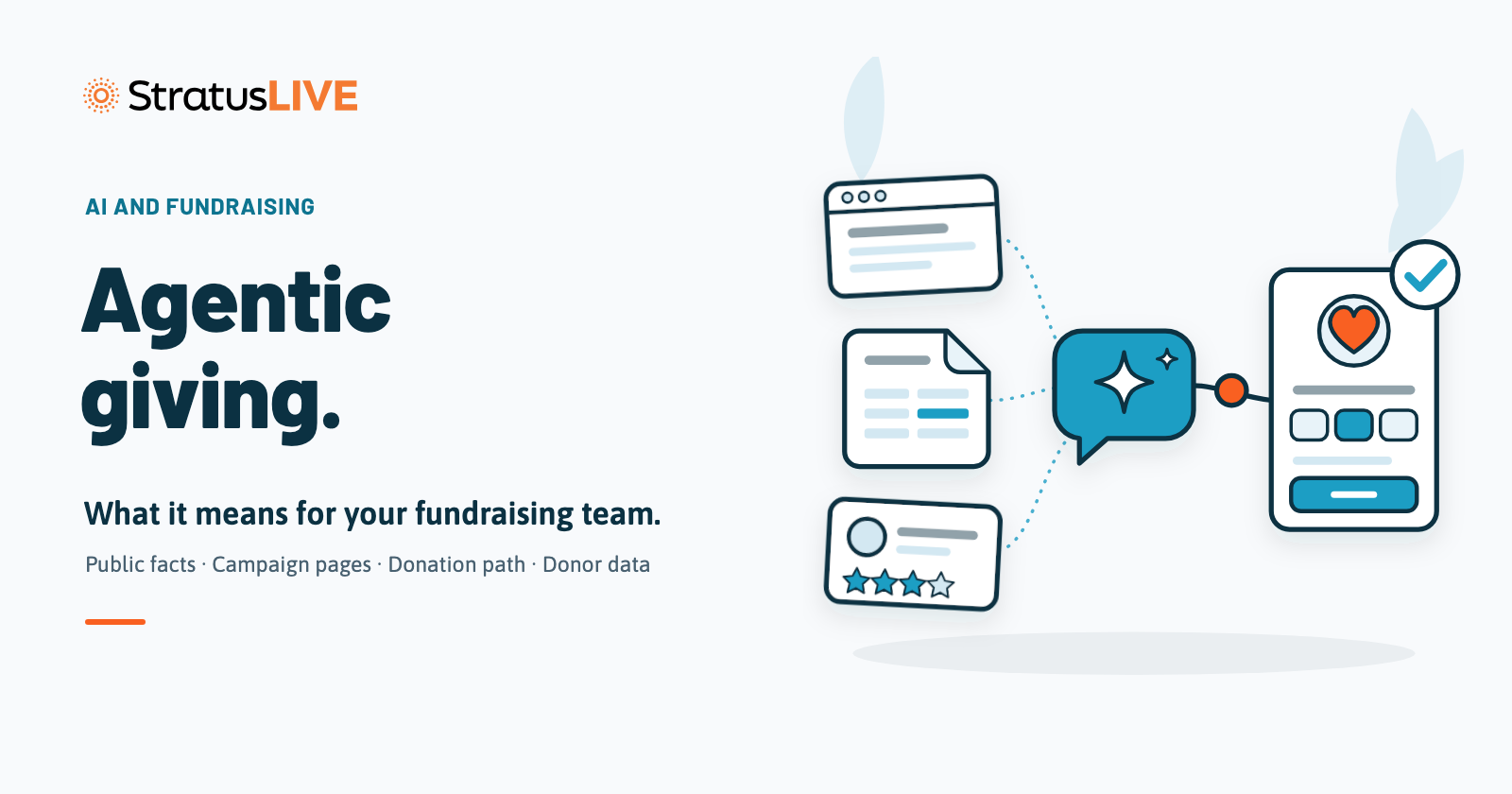
Agentic giving means a donor asks an AI assistant to find a nonprofit, vet it and start a gift. For a fundraising team, the assistant now reads your public facts before any person does. What matters most is already in your control: accurate information about your organization and a donation path that works.
What is agentic giving?
Agentic giving is giving that starts with an instruction to an AI assistant instead of a search box. A donor might ask for “a well-run food bank in Columbus to give to this month.” The assistant searches, compares a few organizations, explains its picks and sends the donor to a donation page. Some tools now go one step further and open the checkout for the donor, who finishes the gift.
The donor still makes the choice. What changes is who reads your information first. AI-referred traffic was small but growing fast last year: Blue State’s study of 24 nonprofit websites, reported by Candid, found that AI-referred traffic was 2% of total visits from January to October 2025, a 1,000% increase over the same period in 2024.
How does an AI assistant decide which nonprofit to recommend?
An assistant can only repeat what it can read. It builds its answer from public sources: your website, your Form 990, charity directory profiles and press coverage. Nobody outside the assistant companies knows exactly how those sources are weighted, so the safe plan is consistent, current facts in all four:
- Your own website, which should state your mission, programs, results and how to give in plain sentences.
- Your Form 990, which reports revenue and program spending in a standard format.
- Charity directory profiles, the listings donors and researchers already use to check a nonprofit.
- Press and community coverage, such as local news and partner pages that mention your work.
A stale program page or a mission statement that differs from your 990 gives the assistant less to work with.
What should a nonprofit fix first?
Fix what a donor would also check. That means accurate facts on your own site, a page for every active campaign, a donation page that works on a phone, and clean donor records with consent preferences.
- Check your public facts. Read your About and Impact pages as if you knew nothing about your organization, then fix outdated numbers and dead links.
- Give every active campaign a page. If your year-end appeal lives only in email, an assistant cannot find it. Each campaign page needs a clear purpose and a giving link.
- Test the donation path. Give on your own donation page from a phone and count the steps it takes. Then check that the receipt email arrives.
- Clean up donor data and consent. New gifts from a new channel land in your donor records. Duplicate records and missing consent preferences make it harder to thank those donors well and to see what is working.
None of this is new advice. Agentic giving raises the cost of skipping it.
Does agentic giving replace donor relationships?
No. An assistant can help a donor make a first or second gift. A major gift depends on trust built over many conversations, and that stays human-led.
What changes is how some relationships start. A donor who found you through an assistant still needs a prompt thank-you and a reason to give again.
Where do AI agents help the fundraising team?
AI agents also work on the staff side: inside your CRM, on your own data, so gift officers spend more time with donors. In the Ignite Active Intelligence Platform, these agents in the Intelligence Hub do that work:
- Prospect Research combines giving history in your CRM with wealth data from your connected screening provider into an evidence-backed profile, so a gift officer can qualify a prospect faster.
- Major Gift helps gift officers prepare for meetings and plan the next cultivation step.
- Retention flags donors at risk of lapsing and recurring gifts that need recovery, so staff can reach out before a donor drifts away.
- Constituent Support answers staff questions about constituent records in plain language.
Agents prepare the work and your team decides what to act on. Your organization sets the approval rules for changes to your records. For how these agents fit together, see AI agents for nonprofits and Ignite Intelligence. Our leader’s guide to AI agents in nonprofits covers where to begin. If your board wants rules for AI use first, start with the nonprofit AI policy template.
Where to start
Agentic giving is early. The steps that prepare you for it are the same steps that serve every donor today: say clearly what you do, keep your public facts consistent, make giving easy and keep your donor data clean. Then give your team the time to do the relationship work no assistant can.
Frequently asked questions
What is agentic giving?
Agentic giving is a donor using an AI assistant to research where to give and, in some cases, to open the checkout. The donor states an intent, such as supporting food security in their city, and the assistant compares organizations and points the donor to a donation page or checkout. The donor still decides. What changes is that software reads your public information first and shapes the short list a donor sees.
How does an AI assistant choose which nonprofit to recommend?
Assistants work from what they can read. For a nonprofit, that means its own website, public filings such as the Form 990, charity directory profiles and news coverage. Current program results, stated the same way across those sources, make an organization easier to describe accurately. Nobody outside the assistant companies knows the exact weighting, so treat any precise ranking formula with suspicion and focus on accurate, consistent facts.
Should a small nonprofit do anything about agentic giving now?
Yes, and most of it is basic upkeep. Check that your website states your mission and results in plain sentences. Confirm your latest Form 990 and directory profiles match your website. Test your donation page on a phone. Then clean up duplicate donor records and consent preferences, because every gift that arrives through a new channel lands in that data.
Will agentic giving replace major gift officers?
No. An assistant can point a donor to a donation page, but a six- or seven-figure gift still depends on trust built over many conversations. Major and mid-level giving stay human-led. The useful role for AI on that side is preparation, such as research before a meeting or a signal when a donor's engagement drops.
Does StratusLIVE Ignite offer agentic giving?
No. Ignite has no feature that lets an outside AI assistant open a checkout for a donor. Its AI agents work on the staff side, inside the Ignite Active Intelligence Platform and on your own CRM data. Prospect Research builds evidence-backed briefs, Major Gift helps gift officers prepare for meetings, Retention flags donors at risk of lapsing and Constituent Support answers staff questions about records. Your organization sets the approval rules for changes.