Key takeaways
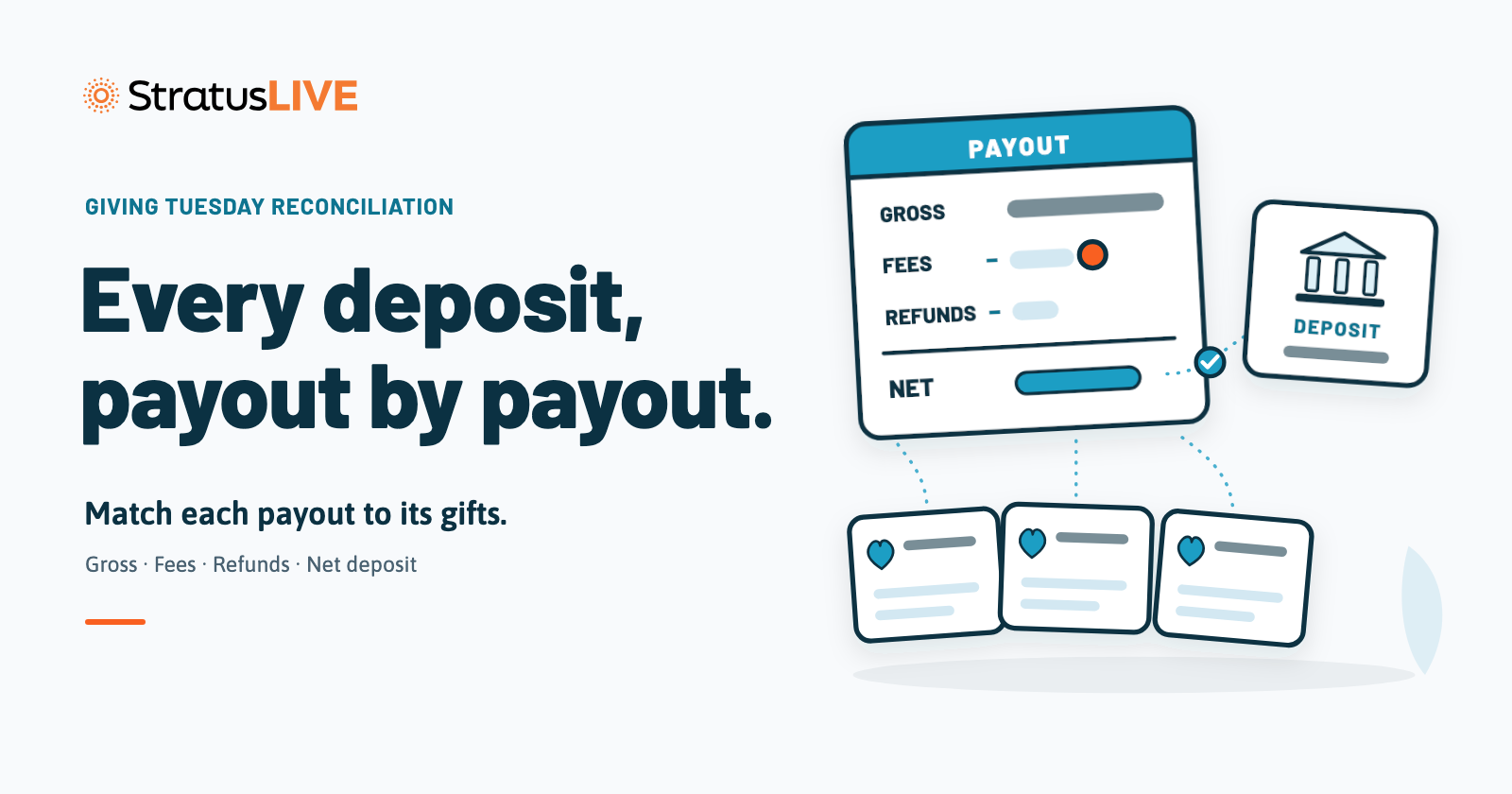
- Reconcile Giving Tuesday one payout at a time. For each deposit, the gross gifts minus fees and refunds must equal the amount that reached the bank, and every gift inside it must match a gift record.
- Card payouts arrive later than the gifts and net of fees. Stripe's default settlement timing for US accounts is 2 business days, and its payout reconciliation report lists the gross, fee and net amount of every transaction.
- Gifts made through PayPal Giving Fund are grants from a donor-advised fund. PayPal Giving Fund pays enrolled charities monthly, in nearly all cases 15 to 45 days after it receives the money.
- A matching challenge that pays only if you hit a goal is a conditional contribution under ASU 2018-08. Book it when you meet the condition, not on the day you announce the match.
- Keep one list of Giving Tuesday money still in transit, with the source, amount and expected date, and clear it before the December close.
To reconcile Giving Tuesday donations, work one payout at a time. For each deposit from your payment processor, the gross gifts minus fees and refunds must equal the amount that reached the bank, and every gift inside it must match a gift record. Money that has not arrived yet, such as donor-advised fund grants and matches, goes on one in-transit list with an expected date. Giving Tuesday 2026 is December 1, so the work runs from December 2 into the year-end close.
Why don’t Giving Tuesday totals match the bank?
Three records have to agree: the gift records in your donor database, the processor’s payout report, and the general ledger where finance books the deposit. They count different things. Your giving page counts gifts when donors make them, at the full amount. The bank counts deposits when processors send them, net of fees. On a normal day the gap is small. On Giving Tuesday, far more gifts than usual arrive in one day, and the gap gets big enough for the board to notice.
Five things cause most of it:
- Fees. A processor takes its fee before it pays you, so the deposit is smaller than the gifts.
- Timing. Stripe’s default settlement timing for US accounts is 2 business days, so on the default daily schedule Tuesday’s card gifts can reach the bank as early as Thursday. A new Stripe account’s first payout typically takes 7 to 14 days.
- Batching. One payout can hold gifts from several days, plus refunds and disputes from earlier ones.
- Third-party platforms. A gift made through PayPal Giving Fund or another donor-advised fund comes later, as a grant.
- Matches. A matching gift may arrive weeks after the challenge, or not count until you meet its goal.
Where each kind of Giving Tuesday money comes from
| Money | When it reaches the bank | What to record |
|---|---|---|
| Card gifts through your own processor | After the processor’s settlement time; 2 business days by default on Stripe in the US | Each gift at full amount on the gift date; the fee as an expense |
| Gifts through PayPal Giving Fund | Monthly, in nearly all cases 15 to 45 days after PayPal Giving Fund receives the money | A grant from PayPal Giving Fund, with the recommending donor credited |
| Grants from a donor’s own donor-advised fund | When the fund’s sponsor sends the grant | The sponsor as payor, the recommending donor credited |
| A matching challenge tied to a goal | When the matching donor pays | A conditional contribution until you meet the goal (ASU 2018-08) |
| Mailed checks | When they arrive and you deposit them | The date the check was mailed, per the mailbox rule |
Sources: Stripe Docs; PayPal Giving Fund Donation Delivery Policy; Johnson Lambert on ASU 2018-08. This is general information, not accounting advice.
For gift dates by payment type, including checks that arrive in January, see our post on the mailbox rule for year-end gifts.
How do you reconcile a Giving Tuesday payout?
Start from the deposit and work backward. Download the itemized report for that payout, check that gross minus fees minus refunds equals the deposit, and then match each charge to a gift in your donor database. A payout is done when the totals tie and every line either matches a gift or sits on an exception list with a reason.
Stripe’s payout reconciliation report gives you the data for the first part. Its itemized file lists every payment, refund, dispute and fee in the payout, with gross, fee and net columns. Two details trip people up. The report groups payouts by estimated arrival date, not the day your bank posts the deposit. And a payout can arrive before its report data is ready, so check the report again the next day before you chase a missing line.
Most exceptions on Giving Tuesday fall into a few groups:
- a gift that exists in the processor report but never made it into the donor database, often from a second giving form
- a duplicate donor record created when a returning donor used a new email address
- a refund for a gift from an earlier day
- a test transaction someone forgot to delete
Gross or net: how should you record processor fees?
Record each gift at the full amount the donor gave, and the processor fee as a separate expense. The donor gave the full amount and their receipt says so. If you book only the net deposit as revenue, your Giving Tuesday total shrinks by the fees, and your gift records no longer agree with your revenue line.
The payout then reads as one equation: gifts minus fees minus refunds equals cash. If your accounting system uses a clearing account, such as undeposited funds in QuickBooks, post the gifts and fees there and clear them with the deposit. If a donor chose to cover the fee, the full amount they paid is the gift. Confirm the fee account and any donor-covered-fee policy with your auditor before December.
Watch designated gifts too. A donor who gives to a named program on Giving Tuesday has usually made a restricted gift, and it belongs in that fund, not in general operating revenue with the rest of the day.
How do you handle money that hasn’t arrived yet?
Keep one in-transit list. Each line names the source, the expected amount, the donor it belongs to and the date you expect it. Card payouts stay off it, because they tie out within days. The list is for money that comes on someone else’s schedule. Review it weekly in December and once more at month-end.
Three kinds of money usually sit on it. Gifts made through PayPal Giving Fund come as a monthly grant, around the end of the month, in nearly all cases 15 to 45 days after PayPal Giving Fund receives the money. PayPal Giving Fund is a donor-advised fund with legal control of those donations, so the payor is PayPal Giving Fund, and the donor who recommended the gift gets the credit. Grants from donors’ own donor-advised funds follow the same pattern, on the sponsor’s schedule.
Matches are the third. A matching donor who pays only if you reach a goal, and keeps the money if you miss it, has made a conditional gift. Under ASU 2018-08, a match requirement is a barrier, and revenue from a conditional contribution is recognized when the condition is met (Johnson Lambert). If the matching donor pays before you hit the goal, the money is a liability until you do. Get the match terms in writing before December 1, so finance knows on the day which case applies.
Who owns what between development and finance?
Split the work by record. Development owns the gift records: the donor, the campaign code, the gift date and the credit. Finance owns the payouts and fee entries, and it runs the close. Many Giving Tuesday mismatches start as a gift record problem, so the fix usually belongs to development even when finance finds it.
Agree on three things in November. Every Giving Tuesday gift, on every form and platform, carries one campaign code. Gifts are dated by the gift date, never the deposit date. And both teams meet once in the second week of December to clear the in-transit list together. For month-end work after that, see our post on aligning gift processing and finance.
The gift side of the reconciliation is simpler when gift processing and finance work from one set of gift records. In Ignite Finance, part of Ignite, the Active Intelligence Platform from StratusLIVE, every gift carries two dates: a donation date for the receipt and an accounting date for the fiscal period. Gifts post in batches, and nothing posts into a closed period. When a donor-advised fund sends a grant, Ignite records the fund as the payor and credits the donor who recommended it. Ignite also checks that the GL extract balances before your accounting system imports it.
A Giving Tuesday reconciliation checklist
- Before December 1, give every Giving Tuesday form, page and platform the same campaign code.
- Get each matching gift’s terms in writing, and decide with finance whether it is conditional.
- Pick the fee account, and write down how you treat donor-covered fees.
- From December 2, reconcile each processor payout as it lands: gross minus fees minus refunds equals the deposit.
- Match every charge to a gift record, and log each exception with a reason.
- Check designated Giving Tuesday gifts against their fund codes before you post the batch.
- Start the in-transit list for PayPal Giving Fund, donor-advised fund grants and matches, with expected dates.
- Bring development and finance together in the second week of December to clear exceptions and the in-transit list.
- Thank donors on time while the numbers settle. Our post on the 48-hour thank-you rule covers the Giving Tuesday window.
Frequently asked questions
Why don't Giving Tuesday donations match the bank deposit?
Because a processor deposits the net amount on its own schedule. Fees, refunds and disputes come out before the money moves, and a payout can mix gifts from more than one day. Stripe's default settlement timing for US accounts is 2 business days, so on the default daily schedule Tuesday's card gifts can reach the bank as early as Thursday. Money given through a donor-advised fund or PayPal Giving Fund arrives weeks later as a separate grant.
Should we record Giving Tuesday gifts at gross or net of fees?
Record each gift at the full amount the donor gave, and record the processor fee as an expense. The donor's receipt shows the full gift, and your fee line shows what the day cost to process. The payout then reconciles as gifts minus fees minus refunds. Confirm the account you use for fees with your auditor.
When do PayPal Giving Fund donations arrive?
PayPal Giving Fund pays enrolled charities once a month, around the end of the month, in nearly all cases within 15 to 45 days after it receives the money. Charities that are not enrolled may get a check instead. PayPal Giving Fund is a donor-advised fund, so the grant comes from PayPal Giving Fund, not from the donor.
How do you record a Giving Tuesday matching gift?
It depends on the terms. If the matching donor pays only when you reach a goal and can keep the money if you miss it, the match is a conditional contribution under ASU 2018-08, and you record it when you meet the goal. A match with no goal attached is an ordinary pledge or gift. Put the terms in writing before December 1 so finance knows which case it is.
Who should own Giving Tuesday reconciliation, development or finance?
Both, with a split. Development owns the gift records: the right donor, campaign code, gift date and credit. Finance owns the payouts and fee entries, and it runs the close. Agree on the split and the dates in November, and meet once in the second week of December to clear the in-transit list together.
How long does Giving Tuesday reconciliation take?
Most card payouts can tie out in early December. The long tail is grants from donor-advised funds and PayPal Giving Fund, which can arrive into January. Plan to close the in-transit list at month-end and carry what is left into the January review.
What date goes on a Giving Tuesday gift that is deposited later?
The gift date, not the deposit date. A card gift is dated by the day of the charge, so a gift charged on December 1 is a December 1 gift even if the payout lands on December 3.