Key takeaways
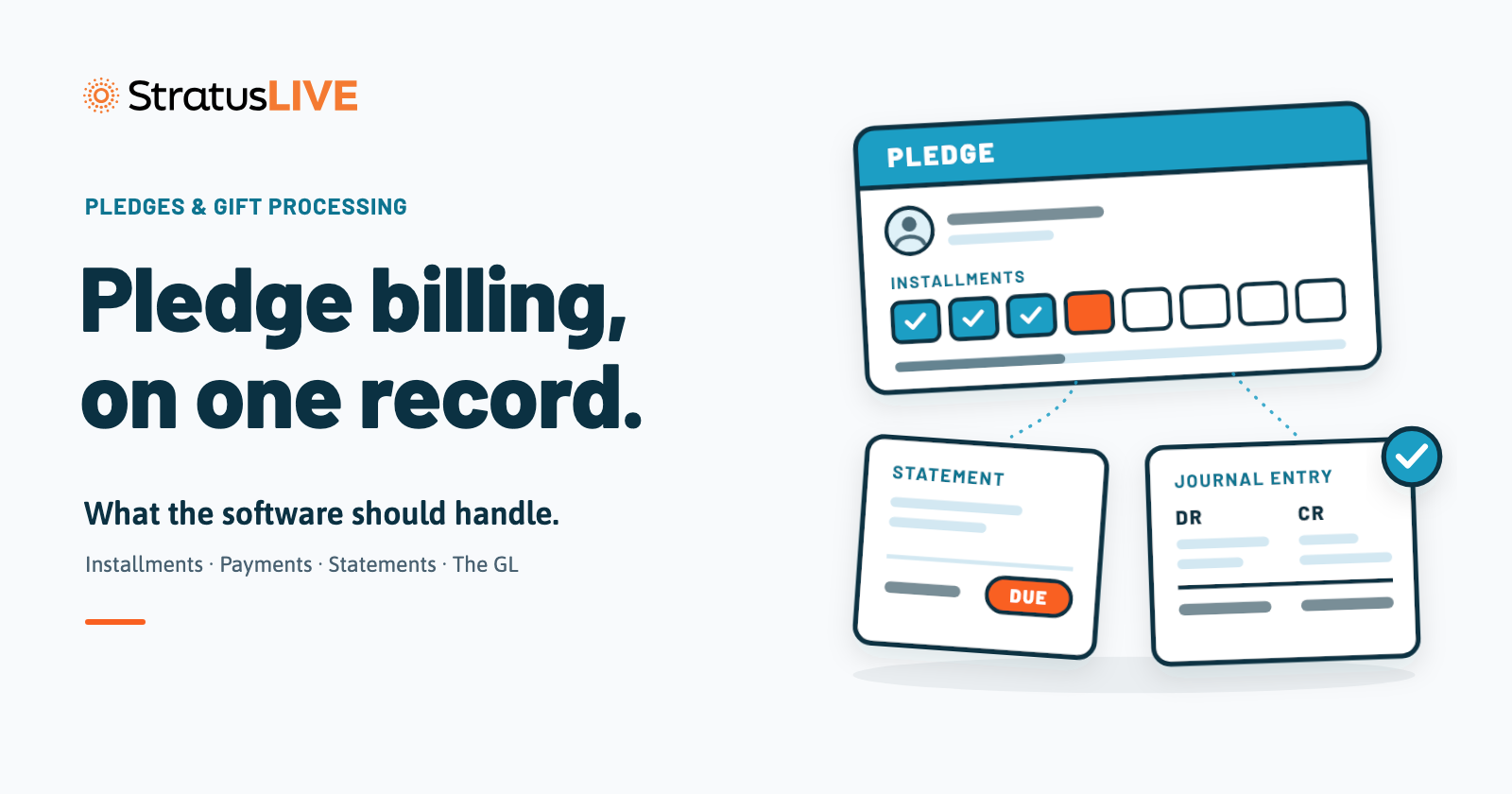
- Pledge billing tracks what a donor still owes on a promise. Gift processing records each payment. Good software does both on one donor record.
- Check installment math first: where an overpayment goes, where a short payment goes, and what happens to the schedule when a donor changes the plan.
- When a DAF, foundation or employer sends the money, the donor should keep giving credit and the payor should be recorded as the party who paid.
- Under FASB ASC 958-605, an unconditional pledge is a receivable. Your pledge data has to agree with the ledger, so ask how payments reach the GL.
- Ignite Finance, in the Ignite Active Intelligence Platform, runs pledges and payments on the record your fundraisers use and exports balanced journal files.
Software that handles pledge billing and gift processing for nonprofits falls into three groups: online giving tools that collect installment payments, donor CRMs that track pledges and remind donors, and fundraising subledgers that do both and post every payment to the general ledger. The right one depends on a single question: does accounting need your pledge numbers to agree with theirs every month? If yes, the pledge, its installments and the journal entries need to live on one record.
Most answers to this question are a list of vendor names. This guide is the checklist a finance director can use to test any of them, written by StratusLIVE, which makes Ignite Finance, part of the Ignite Active Intelligence Platform. We say where Ignite fits near the end.
Pledge billing and gift processing are two different jobs
Pledge billing manages what a donor still owes. It holds the schedule, sends the statement before each installment, and tells someone when a payment is late.
Gift processing manages what came in. Someone enters the check or the card payment, applies it to the right fund and installment, receipts it, and posts it in a batch.
The two jobs break apart in a familiar way. Development tracks the pledge in the CRM, accounting books the receivable in the ledger, and at month-end someone compares a pledge report with a trial balance by hand. Software that does both jobs on one record removes that comparison.
Seven things pledge billing software should handle
Use this table in a demo. The third column is what to ask the vendor to show. You want to see it on screen, not hear it described.
| What to check | Why it matters | Ask the vendor to show |
|---|---|---|
| Installment schedules | Multi-year pledges need a schedule you can see and change | A three-year pledge with quarterly installments |
| Payment application rules | Partial payments and overpayments are normal, and each one changes the balance | A short payment and an overpayment, then the remaining schedule |
| Schedule changes | Donors ask to stretch or move payments | Editing open installments on a posted pledge without touching paid ones |
| Payor separate from donor | DAFs, foundations, IRA custodians and employers pay on a donor’s behalf | A DAF grant toward a donor’s commitment, and who is recorded as paying it |
| Billing statements | For most pledgers, the statement before the due date is the main prompt to pay | A statement run for next month’s installments |
| Donor self-service | Some donors would rather pay online than mail a check | A donor signing in and paying an open pledge |
| The handoff to the GL | Pledge payments have to land in the ledger in balance | A posted batch, its journal entry, and the export file |
If a vendor can show all seven on one record, the month-end comparison mostly goes away. If the answer to the last row is “you export a report and accounting keys it in,” expect the comparison to stay.
Where does pledge billing usually break?
Three setups cause trouble again and again.
The first is a giving form with a pledge feature and nothing behind it. The donor can schedule payments, but the pledge never reaches the donor record your fundraisers use, so a gift officer asks for a new gift from someone who is halfway through a commitment.
The second is a CRM that tracks pledges well but treats accounting as someone else’s problem. Payments are applied, reminders go out, and then a spreadsheet goes to finance. The receivable in the ledger and the open balance in the CRM drift a little every month.
The third is a pledge paid by someone other than the donor. A donor-advised fund sends a check, and the gift lands on the fund’s record instead of the donor’s, or the donor gets a tax receipt they should not receive. Teams fix this with soft credits, which work until someone runs a giving report. DAF grants against personal pledges also carry their own IRS guidance (Notice 2017-73), which is one more reason to record who paid separately from who gave.
The accounting side, in plain terms
Under FASB ASC 958-605, an unconditional promise to give counts as contribution revenue and a receivable when the promise is made, not when the cash arrives. Pledges due in more than one year are measured at present value. A conditional promise is not recognized until its conditions are met or explicitly waived. ASU 2018-08 defines a condition as a barrier the recipient must overcome plus a right of return or release.
For software, that has practical effects. Every pledge needs a status accounting can trust. Every payment needs to reduce the right receivable. And write-offs and cancellations need a record of who did them and why, because your auditor will ask. Your CPA sets the policy; the software’s job is to produce data that already matches it. If you are sorting out which tax year a December payment belongs to, our guide to the mailbox rule for year-end gifts covers the dates by gift type.
How Ignite handles pledge billing and gift processing
Ignite Finance is the fundraising subledger in the Ignite Active Intelligence Platform. Your team processes gifts, pledges, pledge payments and recurring gifts in batches on the same constituent record your fundraisers work from. Against the checklist above:
- A pledge carries a real installment plan. Payments apply to installments in order, an overpayment carries forward, and a short payment rolls into the next installment.
- Open installments on a posted pledge can be edited, and the remaining schedule rebalances.
- Each payment on the installment schedule can name its own payor. Ignite has seven payor types, including DAF sponsor, family foundation, IRA custodian and workplace giving. The donor keeps giving credit, and the payor type decides who is receipted. If one constituent pays another’s pledge, Ignite shows a warning and still accepts the payment.
- Pledge billing statements come from the same template engine as tax receipts and acknowledgements. Staff start each statement run.
- In Ignite Self-Service, donors can see their pledges and pay online.
- Ignite writes journal entries when a batch posts and rejects any batch that does not balance. The GL extract has templates for QuickBooks Online and Microsoft Business Central, plus CSV and XLSX for other ledgers. It is a file your ledger imports, not a live connection.
Ignite Finance does not replace your general ledger. Accounts payable, payroll, bank reconciliation and financial statements stay where they are. The finance leaders page covers what changes for the controller and the CFO, and the five-minute product tour follows one gift through Ignite.
Who should own pledge billing?
In most organizations, development owns the relationship and finance owns the receivable. The trouble starts when each team keeps its own copy of the pledge. A workable split: development sets up the pledge and talks to the donor about changes, gift processing applies payments in batches, and finance reviews the receivable and the export each month. Nobody builds a comparison by hand at month-end.
Food banks and other organizations with heavy batch volume feel this first. Our post on aligning fundraising and finance at food banks walks through the batch side, and the recurring giving flywheel covers monthly donors, who behave differently from pledgers.
If your pledge report and your trial balance disagree every month, bring both to a working session and we will run a pledge like yours through Ignite Finance with you.
Frequently asked questions
What software handles pledge billing for nonprofits?
Three kinds of software touch pledges: online giving tools that take installment payments, donor CRMs that track the pledge and send reminders, and finance subledgers that also post each payment to the general ledger. If you only need to collect payments online, a giving tool can work. If accounting has to agree with development every month, look for software that keeps the pledge, the installments and the journal entries on one record.
What is the difference between pledge billing and gift processing?
Pledge billing is the work of tracking a promise to give and asking for each payment when it comes due: the schedule, the statements, the follow-up. Gift processing is recording each payment that arrives: entering it, applying it to the right designation and installment, receipting it and posting it. One manages what is owed, the other manages what came in, and both have to agree.
How should software apply a pledge payment that does not match the installment?
It should follow a rule you can explain to an auditor. A common one: apply payments to installments in date order, carry an overpayment forward to the next installment, and roll a short payment into the next one. Ask the vendor to show you a partial payment and an overpayment live, then look at the remaining schedule and the receivable balance afterward.
Who gets credit when a donor-advised fund pays a pledge?
The donor who recommended the grant keeps giving credit for relationship and reporting purposes. The sponsoring organization that sent the money is the payor, the party the payment legally comes from, and that affects receipting. IRS Notice 2017-73 addresses DAF grants and donors' personal pledges, so ask your auditor how you record a DAF grant against a pledge. Software that records the payor separately from the donor keeps both right without a soft-credit workaround.
How are pledges recorded in nonprofit accounting?
Under FASB ASC 958-605, an unconditional promise to give is recognized as contribution revenue and a receivable when it is made. Pledges due in more than one year are measured at present value. Conditional promises are not recognized until the conditions are met or explicitly waived. Your auditor or CPA sets the policy; your pledge software has to produce data that matches it.
Does Ignite Finance replace our accounting system?
No. Ignite Finance is the fundraising subledger in the Ignite Active Intelligence Platform. It processes gifts, pledges, pledge payments and recurring gifts into balanced journal entries, then produces a fund-coded export with templates for QuickBooks Online and Microsoft Business Central, plus CSV and XLSX for other ledgers. Accounts payable, payroll, bank reconciliation and financial statements stay in your general ledger.