Key takeaways
- The common rule is three to six months of operating expenses in reserve, with a floor of one full payroll and a ceiling of two years' budget (Propel Nonprofits). The Nonprofit Operating Reserves Initiative workgroup suggests a minimum of 25%, or three months, at the year's lowest point.
- An operating reserve is unrestricted money you can spend. Restricted gifts and the equity in buildings and equipment do not count, so a large balance sheet can hide a small reserve.
- To calculate it from your Form 990, take Part X line 27 (net assets without donor restrictions), subtract the equity in your fixed assets, divide by Part IX line 25 (total expenses), and multiply by 12 to get months.
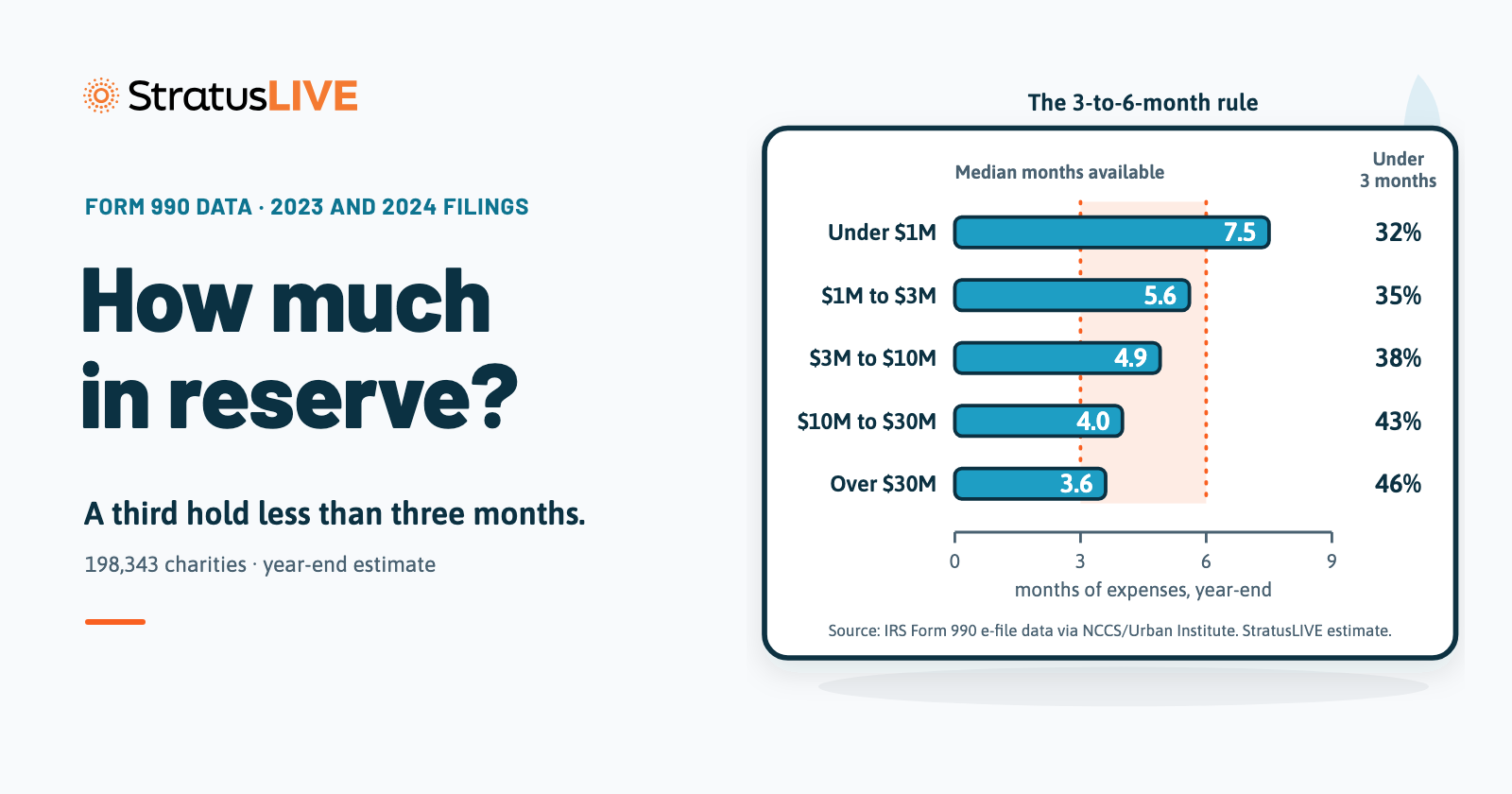
- On their latest Form 990s (tax year 2023 or 2024), 34% of 198,343 charities had less than three months of expenses available for operating reserves at year-end, and 49% had less than six, by our estimate from the balance sheet. Larger charities held fewer months: the median for charities over $30M in revenue was 3.6 months.
- In the Nonprofit Finance Fund's 2025 survey, 52% of respondents had three months or less of cash on hand.
A nonprofit should hold three to six months of operating expenses in reserve. That is the most widely cited rule: Propel Nonprofits gives three to six months as the usual goal, and the Nonprofit Operating Reserves Initiative workgroup suggests a minimum of 25%, about three months, at the year’s lowest cash point. By our estimate from 198,343 charities’ latest Form 990 balance sheets, 34% had less than three months of expenses available for operating reserves at year-end.
What is the 3-to-6-month rule?
The 3-to-6-month rule says a nonprofit should keep enough unrestricted money to pay three to six months of operating expenses with no new revenue. Propel Nonprofits adds a ceiling and a floor: no more than two years’ budget, and at least one full payroll, including taxes. The rule is a starting point. Each board sets its own target.
The National Council of Nonprofits’ reserves page quotes Kate Barr of Propel Nonprofits on the limit of any single rule: “It’s a myth, however, that a single standard applies for all nonprofits.”
What counts as an operating reserve?
An operating reserve is unrestricted money the board can spend on operations. Gifts a donor restricted to a program or a future year do not count, because they can only be spent as the donor directed. The equity in your building does not count either, because you cannot pay staff with a roof.
The Operating Reserve Policy Toolkit (2010) gives a widely used definition: available unrestricted net assets equal total unrestricted net assets less the equity in fixed assets. The Nonprofit Financial Commons calls the same idea LUNA, for liquid unrestricted net assets.
Board-designated funds are unrestricted, but the board has set them aside for a purpose. Count them in the reserve only if the board would release them for operations.
How do you calculate your operating reserve ratio?
Your operating reserve ratio is your operating reserve divided by your annual operating expenses. Multiply the ratio by 12 to get months. From a Form 990, start with Part X line 27, subtract the equity in your land, buildings and equipment, and divide by Part IX line 25.
The Form 990 lines are:
- Net assets without donor restrictions: Part X, line 27 (for organizations that follow FASB ASC 958; others use lines 29 to 31).
- Land, buildings and equipment, net of depreciation: Part X, line 10c.
- Debt on those assets, such as a mortgage or tax-exempt bonds: usually part of Part X, line 23 or line 20.
- Equity in fixed assets: line 10c minus that debt.
- Total expenses: Part IX, line 25 (or your board-approved operating budget for the coming year).
The toolkit works through an example. Total unrestricted net assets are $587,000. Fixed assets of $423,000 carry a $75,000 mortgage, so the equity in fixed assets is $348,000. That leaves $239,000 available for an operating reserve. Against a $500,000 budget, the operating reserve ratio is 47.8%, or about 5.7 months.
| Step | Amount |
|---|---|
| Total unrestricted net assets | $587,000 |
| Less equity in fixed assets ($423,000 net fixed assets minus a $75,000 mortgage) | ($348,000) |
| Available for operating reserves | $239,000 |
| Annual operating expense budget | $500,000 |
| Operating reserve ratio | 47.8% (about 5.7 months) |
Example from the Operating Reserve Policy Toolkit, Figure C4.
The toolkit calls this measure “available for operating reserves” and notes it “is the only definition that can be used with IRS Form 990 data.” To count board-designated funds, you need your own books.
How much do nonprofits actually hold?
A third hold less than the three-month floor. By our Form 990 estimate, 34% of 198,343 charities had less than three months of expenses available for operating reserves, and 49% had less than six. In the Nonprofit Finance Fund’s 2025 survey, 52% of respondents had three months or less of cash on hand, and 18% had one month or less.
We used the toolkit’s definition on 198,343 charities, from the same IRS e-file data behind our Peer Benchmark tool, plus the Part X balance sheets. On each charity’s latest return for tax year 2023 or 2024 (full-year returns only), we took net assets without donor restrictions (Part X, line 27) and subtracted the equity in land, buildings and equipment: line 10c minus the debt on lines 23 and 20, set to zero when the debt is larger. Then we divided by one month of total expenses (Part I, line 18, the same total as Part IX, line 25). This is the most a charity could treat as an operating reserve. It includes more than cash: board-designated funds, receivables and investments count too.
| Revenue band | Charities | Median months available for operating reserves | Under 3 months | Under 6 months | Below zero |
|---|---|---|---|---|---|
| Under $1M | 119,559 | 7.5 | 32% | 45% | 12% |
| $1M to $3M | 36,053 | 5.6 | 35% | 52% | 12% |
| $3M to $10M | 23,549 | 4.9 | 38% | 55% | 13% |
| $10M to $30M | 11,112 | 4.0 | 43% | 61% | 16% |
| Over $30M | 8,070 | 3.6 | 46% | 65% | 17% |
| All charities | 198,343 | 6.2 | 34% | 49% | 12% |
Source: StratusLIVE analysis of IRS Form 990 e-file data (NCCS/Urban Institute), 501(c)(3) organizations that file the full Form 990 and report net assets with and without donor restrictions, latest full-year return for tax year 2023 or 2024. Available for operating reserves = Part X line 27 minus the equity in fixed assets (line 10c minus lines 20 and 23, with the equity set to zero when the debt is larger). Year-end figures. How the base sample is built: Peer Benchmark methodology.
The share below the three-month floor grows with size. The median charity under $1M in revenue held 7.5 months. The median charity over $30M held 3.6 months, and 46% of the largest charities were below three months. About one charity in eight was below zero by this measure. For most of them, unrestricted net assets were already below zero (7% of all charities). For the rest, the equity in buildings and equipment was larger than their unrestricted net assets.
The definition matters. The same 198,343 charities had a median of 12.6 months of total net assets, and only 20% had less than three months. Taking out donor-restricted funds and the equity in buildings cuts the median about in half. These are estimates from year-end balance sheets, and year-end may not be the year’s low point. Line 23 can include debt that is not on buildings, and the filings do not show which unrestricted funds the board has designated. Most of these limits make the measure read high, so the share of charities below three months is probably higher than 34%. Read the table as a picture of charities that file the full Form 990. For your own ratio, use your own financial statements. (For overhead and program spending in the same Form 990 data, see our overhead ratio analysis.)
Can a nonprofit have too much in reserves?
Yes, by the standards donors and watchdogs use. Federal tax law sets no reserve cap for a public charity. Propel Nonprofits suggests no more than two years’ budget, and the BBB Wise Giving Alliance’s Standard 10 draws its line at three times the past year’s expenses or the current year’s budget, whichever is higher.
A charity above the BBB line can still meet the standard if it discloses certain information about its financial position on its website and in its appeals. By our Form 990 estimate, 20% of charities had more than two years of expenses available for operating reserves, above Propel’s ceiling, and 15% had more than three times last year’s expenses. Three in four of those over two years had under $1M in revenue. Our post on the 33 percent rule explains which payout rules apply to foundations and which do not.
How do you set a reserve target for your organization?
Start from your floor and your risks. Cover one full payroll at the year’s lowest cash point, then add months for each risk your revenue carries: slow government reimbursements, a few large donors, a seasonal year-end. Write the target into a board policy that also says when you may draw on the reserve and how you pay it back.
- Find your low point. Look at 24 months of monthly cash and mark the month with the least cash. That is the month your reserve has to cover.
- Set the floor at one full payroll, including taxes, per Propel Nonprofits.
- Add months for each risk. Each of these argues for more: a government grant paid three months late, a top donor who could stop giving (our 80/20 rule post shows how to measure that concentration), a December that brings in a large share of the year’s gifts.
- Check the result against the ceiling: two years’ budget (Propel) or three times expenses (BBB Wise Giving Alliance).
- Write the policy. The National Council of Nonprofits lists five parts: how much you keep in reserve at all times, when you may use it, how you decide to draw on it, how and when you pay it back, and any limits on what it may pay for.
- Report the ratio to the board every quarter, in months.
Why your reserve number depends on clean gift coding
You can count the reserve only if you know which money is restricted. That starts at gift entry. A gift entered without its fund often lands in an unrestricted or default fund, and the reserve looks larger than it is until the auditor finds the restriction.
In Ignite Finance, part of StratusLIVE’s Ignite platform, every gift carries its campaign and at least one designation when it is entered, and the designation carries its fund and restriction class. Batches post as balanced double-entry journal entries, and the trial balance lives in the platform. Your finance team exports a balanced one-way file to the general ledger, formatted with QuickBooks Online or Business Central templates, and marks it reconciled once the ledger agrees. Your accounting system stays the general ledger of record, and each gift’s restriction is set when the gift is entered. Our page on fundraising and finance on one record follows one batch from entry to the ledger, and our page for finance leaders covers the rest of the finance view.
An operating reserve checklist
- Calculate available unrestricted net assets: net assets without donor restrictions minus the equity in fixed assets.
- Divide by a year of operating expenses and multiply by 12 to get months.
- Set a floor of one full payroll and a target of three to six months, adjusted for your revenue risks.
- Keep it under two years’ budget, or explain why it is higher.
- Write a board policy: amount, uses, decision process, repayment, limits.
- Check that every gift is coded to its fund, so restricted money never counts as reserve.
- Report the ratio in months every quarter.
Frequently asked questions
What is a good operating reserve ratio?
Between 25% and 50% of annual operating expenses, which is three to six months. The Nonprofit Operating Reserves Initiative workgroup suggests 25% as the minimum at the lowest point of the year, and Propel Nonprofits gives three to six months as the common goal. Organizations with slow government reimbursements, a few large donors or a seasonal year-end should aim toward the top of that range.
How many months of reserves do most nonprofits have?
The median is about six months, and the range is wide. By our estimate from 198,343 charities' latest Form 990 balance sheets, the median charity had 6.2 months of expenses available for operating reserves: net assets without donor restrictions minus the equity in buildings and equipment. A quarter had less than 1.5 months, and a quarter had more than 17.6. A third had less than three months. Larger charities held fewer months: the median for charities over $30M in revenue was 3.6.
How much money can a nonprofit have in reserve?
As much as its board can justify. Federal tax law sets no cap on a public charity's reserve. Propel Nonprofits suggests reserves should not exceed two years' budget, and the BBB Wise Giving Alliance's Standard 10 draws its line at three times the past year's expenses or the current budget, whichever is higher. A charity above that line can still meet the standard if it discloses certain information about its financial position on its website and in its appeals.
Do restricted funds count as reserves?
No. Money a donor restricted to a program, a project or a future year can only be spent as the donor directed, so it cannot cover payroll in a bad month. An operating reserve is unrestricted. Board-designated funds are unrestricted, but the board has set them aside, so count them only if the board would release them for operations.
What is LUNA?
LUNA stands for liquid unrestricted net assets, the name the Nonprofit Financial Commons uses for the unrestricted money an organization can spend. The 2010 Operating Reserve Policy Toolkit defines the same idea as available unrestricted net assets: total unrestricted net assets less the equity in fixed assets. Either way, it is the closest single measure of an operating reserve.
Is three months of reserves enough?
Three months is the usual floor, and most boards should aim higher. It covers a late grant payment or a short gap in revenue. Organizations with lumpy revenue, government reimbursement grants or a few large donors usually need more. The Nonprofit Operating Reserves Initiative workgroup suggests 25%, about three months, as a minimum, and Propel Nonprofits gives three to six months as the common goal. By our Form 990 estimate, a third of charities held less than three months.
What should a nonprofit reserve policy include?
The National Council of Nonprofits lists five parts: how much the organization keeps in reserve at all times, the circumstances that allow it to use the reserve, the process for deciding to draw on it, the process and timeline for paying it back, and any limits on what reserve money may be used for.
Where do I find my reserve numbers on Form 990?
On the Part X balance sheet. For organizations that follow FASB ASC 958, line 27 shows net assets without donor restrictions and line 28 shows net assets with donor restrictions (others use lines 29 to 31). Line 10c shows land, buildings and equipment net of depreciation. Debt on those assets is usually in line 23 (secured mortgages and notes payable) or line 20 (tax-exempt bond liabilities). Part IX line 25 gives total expenses. These are year-end figures, so a mid-year check needs your own financial statements.