Key takeaways
- A demo can't show ROI. Run a pilot on one workflow, measured against a control group drawn from the same donor pool.
- Write the pass line before the pilot starts: the metric, the lift you need, and the date you will judge it.
- Hours saved count toward ROI only when the time goes to work that raises money, like more donor conversations.
- Count the full cost: the subscription plus setup, data cleanup, staff review time, training and usage.
- Pick pilot donors at random. Give the AI only your weakest prospects and the results will look worse than they are.
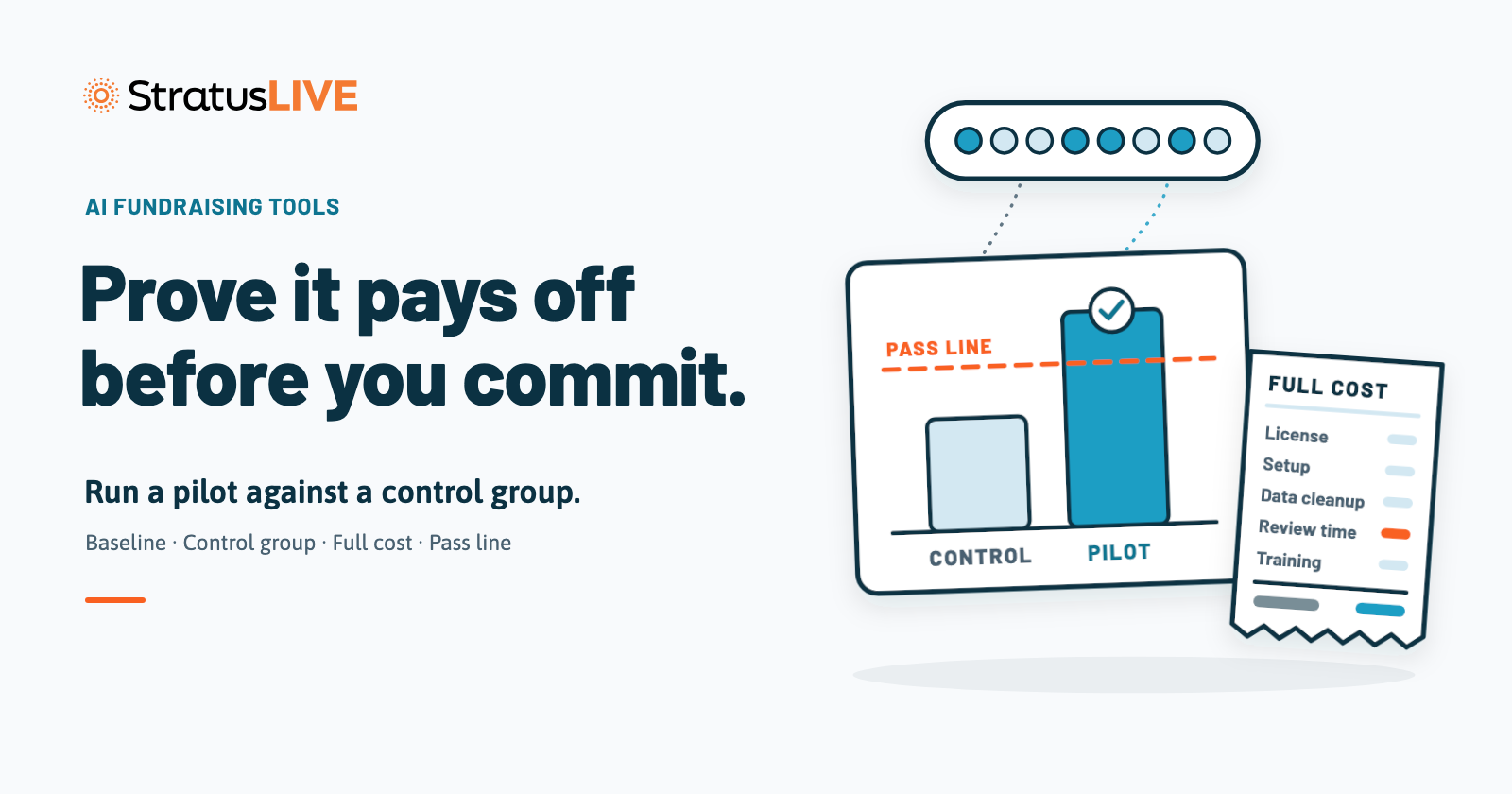
The way to prove an AI fundraising tool will pay off is a small, controlled pilot. Pick one fundraising workflow and write down your baseline from your own records. Run the tool on a randomly chosen part of one donor segment while the rest gets your normal approach, then compare the results against the tool’s full cost. Set the pass line before you start. If the pilot group beats the control group by that margin, you have a business case. If it does not, you have found out cheaply.
Can a demo prove ROI?
No. A demo shows the tool at its best, on clean sample data, run by the person who knows it best. Your results depend on your data, your team’s habits and your donors. The only way to see those effects is to run the tool on your own records against a fair comparison. Treat the demo as a reason to run a test.
Step 1: Pick one workflow and one money metric
Test one job, not a whole fundraising transformation. Choose a workflow where the AI does something specific and where you can tie the outcome to dollars or to a step that leads to dollars.
| Workflow you test | Leading signal (moves first) | Money metric (the ROI) |
|---|---|---|
| Renewal and lapsed-donor outreach | Response rate | Renewal rate and revenue per donor |
| Major gift prospect prioritization | Qualified meetings booked | New moves and pipeline value |
| Gift acknowledgments and stewardship | Days from gift to thank-you | Second-gift and retention rate |
| Ask amounts on appeals | Average gift | Total revenue against control |
| Gift entry and data cleanup | Hours per batch | Hours moved to donor-facing work |
For prospect prioritization, our post on predicting donor giving patterns with an AI-enabled CRM explains what those models look at. If you are weighing which workflows to try, our list of AI tools for nonprofits by use case groups the options by job.
Step 2: Write down the baseline from your own records
Pull the same metric for the same segment over the last six to twelve months: renewal rate, average gift, meetings per officer, hours spent per batch. Without a baseline you cannot measure lift, and you will end up arguing about impressions. If you need an outside reference point, compare your figures with sector numbers in our nonprofit fundraising benchmarks, but judge the pilot against your own history.
Step 3: Hold out a control group from the same donor pool
Split one segment at random. Half gets the AI-assisted approach; half gets what you do today. Run both halves in the same appeal at the same time. The control group is what turns a good-looking result into evidence.
Living Beyond Breast Cancer ran a controlled test on AI-set ask amounts. It tested the AI gift arrays with half of its donor community, focused on its highest-capacity segments, and compared total donations against a control group. LBBC’s own team reported a 12% lift in total donations over the control group in a client spotlight published by its agency, Thread Strategies (February 2023).
Random assignment matters because who you give the tool shapes the result. When the Chronicle of Philanthropy reported on universities testing an AI fundraiser (August 2025), William & Mary’s Matthew Lambert said the school started cautiously by giving the tool non-donors and low-potential donors, and that schools that assigned higher-potential donors saw stronger results. Hand the AI only your hardest cases and it will look worse than it is. Hand it only your best and it will look better.
Step 4: Count the full cost, not the license
The subscription is only one line. A fair cost figure includes:
- Setup and integration with your CRM
- Data cleanup the tool needs before it works well
- Staff time to review, edit and approve what the tool produces
- Training and the slower weeks while people learn it
- Usage or volume charges as the pilot scales up
The review line is the one teams forget. A tool that drafts a stack of renewal letters still needs someone to read them. Your AI policy should say who checks AI output before it reaches a donor, and that time belongs in the cost.
Step 5: Set the pass line and the formula in advance
Write one sentence before the pilot starts: “We will adopt the tool if the pilot group beats the control group by X on metric Y by date Z.” Finance should sign it too. Then use one formula:
ROI = (extra net revenue + value of hours moved to fundraising work − full cost) ÷ full cost
Hours count only when you can show where they went. Time saved on gift entry that turns into more donor calls is return. Time saved that disappears into the inbox is not. Our fundraising capacity calculator estimates how many weekly hours of repeatable operational work could come back to your team, which gives you a starting point for the hours side of the formula.
Step 6: Run it for one full cycle of the workflow
Match the pilot length to the work. A renewal appeal or acknowledgment test can read out after one cycle. A major gift test will not see closed gifts inside a pilot, so judge it on leading signals: qualified meetings, new moves and proposals in progress. Set the review date in advance and do not extend it because the numbers are close.
What goes wrong in AI fundraising pilots
- No control group, so results that rise in a good giving season get credited to the tool.
- Cherry-picked donors: the pilot gets the easiest or the hardest cases, so the result reflects the list, not the tool.
- Moving goalposts, where the metric changes halfway through because the first one did not move.
- Hours saved are counted, but nobody can say what they were used for.
- The vendor scores its own result. Export the data and check it yourself.
- Dirty data: the tool works on duplicates and stale addresses, then gets blamed for the outcome.
Questions to ask the vendor before you start
- Does the tool work on our own donor records, or on an exported copy?
- Who sees and approves what it does before anything reaches a donor?
- What does the full cost include beyond the license?
- Can we export the pilot and control data to check results ourselves?
- Can we talk to a customer who ran a controlled test?
- What does the tool do when our data is incomplete?
For the wider questions about how AI agents should fit a fundraising team, see our leader’s guide to AI agents in nonprofits.
Running the pilot where your data lives
Measurement is easier when the AI works inside the system that already holds your gift history. In the Ignite Active Intelligence Platform, agents run from the Intelligence Hub on the same constituent records your team reports from, so your gift history, the donors in each group and the results sit in one place. The work stays human-led and AI-assisted: your team decides what the agents do and sets the review gates for what reaches donors. The hours it gives back go to donor work you can count. To see how that looks on real screens, take the Ignite product tour. If you are comparing CRMs as part of this decision, our guide to what to look for in a nonprofit CRM covers the rest of the checklist.
Frequently asked questions
How do you measure the ROI of an AI fundraising tool?
Compare the pilot group with a control group drawn from the same donor pool over the same period. Take the difference in revenue, retention or qualified meetings, add the value of staff hours that went to other fundraising work, and subtract the full cost of the tool: subscription, setup, data cleanup, training and the staff time spent checking its output. Divide by that full cost. If the result clears the pass line you set before the pilot began, the tool paid off.
What should an AI fundraising pilot measure?
One money metric tied to the workflow you are testing, plus one leading signal that moves sooner. For renewal outreach, measure renewal rate and revenue per donor, with response rate as the early signal. For major gift prospecting, measure qualified meetings and new moves, because closed gifts take longer than most pilots run. Agree on both metrics with finance before the pilot starts, so nobody changes the scoreboard halfway through.
How big does the control group need to be?
Big enough that a normal swing in giving does not look like a win. Split one donor segment at random into two groups of similar size and history. Small segments produce noisy results, so test where you have volume, such as a renewal appeal or a lapsed-donor list. For a small major gift portfolio, compare against the same officers' prior results and lean on leading indicators rather than dollars.
Do staff hours saved count as return on investment?
Only when you can show where the hours went. Saved time that disappears into email is not a return. Saved time that turns into more donor visits, faster acknowledgments or a stewardship call list that gets worked is return you can count. Track what staff did with the time during the pilot, and value it by the fundraising work it made possible.
How long should an AI fundraising pilot run?
Long enough to cover one full cycle of the workflow you are testing. A renewal or acknowledgment test can read out after one appeal cycle. A major gift test needs longer, so judge it on leading indicators such as qualified meetings and moves while the gifts are still in cultivation. Set the review date in advance and hold to it.
What should we ask an AI fundraising vendor before a pilot?
Ask whether the tool runs on your own donor records or on a copy, who can see and approve what it does before anything reaches a donor, what the full cost includes beyond the license, and whether you can export the pilot data to check the results yourself. Ask for a customer who ran a controlled test, not just a testimonial, and ask what the tool does when your data is incomplete.