01
The reconciliation marathon
Fundraising exports a spreadsheet, finance keys it into the general ledger, and the two numbers still do not match. Month-end becomes a hunt for the difference.
Ignite Finance
Ignite Finance runs batches of gifts, pledges, and recurring giving through one engine that feeds journal entries, trial balance, and a balance-verified GL extract, so development and accounting stop reconciling two systems.
The month-end tax
Development reports one number. Accounting certifies another. Closing the gap between them is somebody's week, every month.
01
Fundraising exports a spreadsheet, finance keys it into the general ledger, and the two numbers still do not match. Month-end becomes a hunt for the difference.
02
A donor-advised fund check arrives from an intermediary, and crediting it to the donor who deserves it is a manual detective exercise every time.
03
Batches, pledges, and recurring gifts live in one system; the statement lives in another. Every handoff is a chance for the numbers to drift.
Batches of gifts, pledges, and journal entries are platform records on the same constituent data your fundraisers work from, not a second ledger to keep in step.
Batch entry
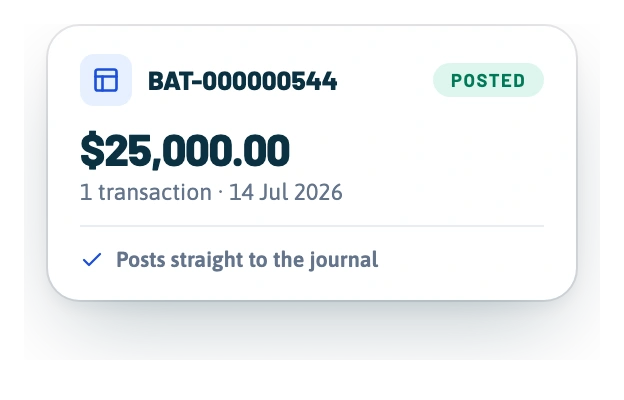
Transaction counts, amounts, dates, entry types, and posting status sit in one working grid, so nobody has to ask which batch is open and which one already posted.
Batch operations
The Batch Operations dashboard rolls the backlog, the posting pace, and the posted value into one view, so a slow week surfaces before month-end finds it.
Fiscal-year journals
Fiscal-year totals and account-level activity live inside the financial record, so reviewing the year does not mean waiting on an export from another system.
The handoff
The gap between fundraising and accounting closes at the source, so the extract is a formality instead of the start of an investigation.
The GL extract engine verifies that the extract balances and stamps a checksum before anything leaves the building.
Export templates for QuickBooks Online and Microsoft Business Central, plus clean CSV and XLSX for any other general ledger.
Each extract moves from generated to exported to reconciled, with re-open and discard permission-gated and logged.
Funds carry names, codes, restriction classification, and status, so restricted money posts where it belongs.
Enter the gift once. It carries all the way to the statement.
Ignite Finance
Watch a gift travel from donation to statement.
See one live workflow in 30 minutes, with real data and no slide deck.
Gift processors, accountants, and development leadership each get a working view built for their job, and all three are reading the same record.
Open batch
Rapid entry, defaults applied
Third-party payor
DAF gift, donor hard-credited
Pledge installment
Posted on schedule
GL extract
Balance verified, checksum stamped
Trial balance
Debits and credits agree
Adjustment
Reversal recorded on the gift
Financial overview
Volume, batches, recent activity
Gift attribution
Gifts linked to opportunities
One number
Fundraising and finance agree
The capability list
One module, from donation to statement. Every capability below works on the same live record fundraising works.
Every gift type, entered once.
The gift as the donor intended it, recorded that way.
From donation to statement, verifiably.
The rails, and the records behind them.
| A CRM plus a spreadsheet | Ignite Finance | |
|---|---|---|
| Month-end | Export, re-key, hunt for the difference | One record; the numbers already agree |
| Gift to GL | Manual journal entries after the fact | Journal entries generated on entry |
| DAF gifts | Detective work to credit the donor | Donor hard-credited, DAF recorded as payor |
| The extract | A file you hope balances | Balance-verified with a checksum |
| Restricted funds | A convention the team remembers | Classification carried on the fund record |
| Source of truth | Two systems, two numbers | One record, one number |
Proven foundation
Ignite is a new platform, built by the team nonprofits have trusted with their constituent and financial data for over 15 years.

4.5/5
Average on G2.
20M+
Constituent profiles managed across the StratusLIVE platform family.
$1B+
In annual giving processed across the StratusLIVE platform family.
“One source of the truth about our contacts, donors, and partners that is easily kept up to date.”
Robert W.
Director of Fundraising Operations & Digital Solutions
Verified review · G2
“A powerful tool that empowers our team members to not only enter new data but also see a historical perspective of our donors and corporate partners.”
Maria M.
Director of Investor Management
Verified review · G2
“Removes the need for manual import and export of data.”
Charmaine V.
Small-business nonprofit
Verified review · G2
Questions
Direct answers, because you've sat through enough vendor slides.
Book a working sessionThe GL extract engine generates balanced, checksum-verified extracts and exports them as files your accounting system imports, with dedicated templates for QuickBooks Online and Business Central, plus clean CSV or XLSX for any other general ledger. These are formatted export files rather than a live two-way connection. Journal entries and trial balance live inside the platform, so what you hand accounting is already reconciled.
Every gift, pledge payment, and recurring charge is processed once and carries through to journal entries, trial balance, and GL extract inside the same platform. Development and finance look at the same record, so month-end stops being a reconciliation exercise between a CRM export and the accounting system.
Stripe and PayPal gateways, with ACH via PayPal Payflow, and Apple Pay and Google Pay through our integrated giving experience. Donor-advised funds and other intermediaries get first-class payor records, so the check from a sponsoring organization credits the right donor.
Funds are records in the platform, each carrying a name, code, restriction classification, and active status. Because the classification lives on the fund rather than in a team convention, restricted and unrestricted money posts to the right place and the extract reflects it.
Yes. Acknowledgements, receipts, and billing statements are templated, scheduled, and driven by conditional logic, generated from the same record that processed the gift. Donors also download their own year-end tax statements through the Ignite Self-Service donor portal, so receipting stops being a January project.
No. Ignite Finance is the nonprofit subledger, not a replacement for your general ledger. It handles gift processing, batches, pledges, adjustments, and fund accounting on the same record as fundraising, then hands your GL a balanced file. Your accounting system stays where it is.
See a batch post, a trial balance agree, and an extract come out balanced, in one demo.